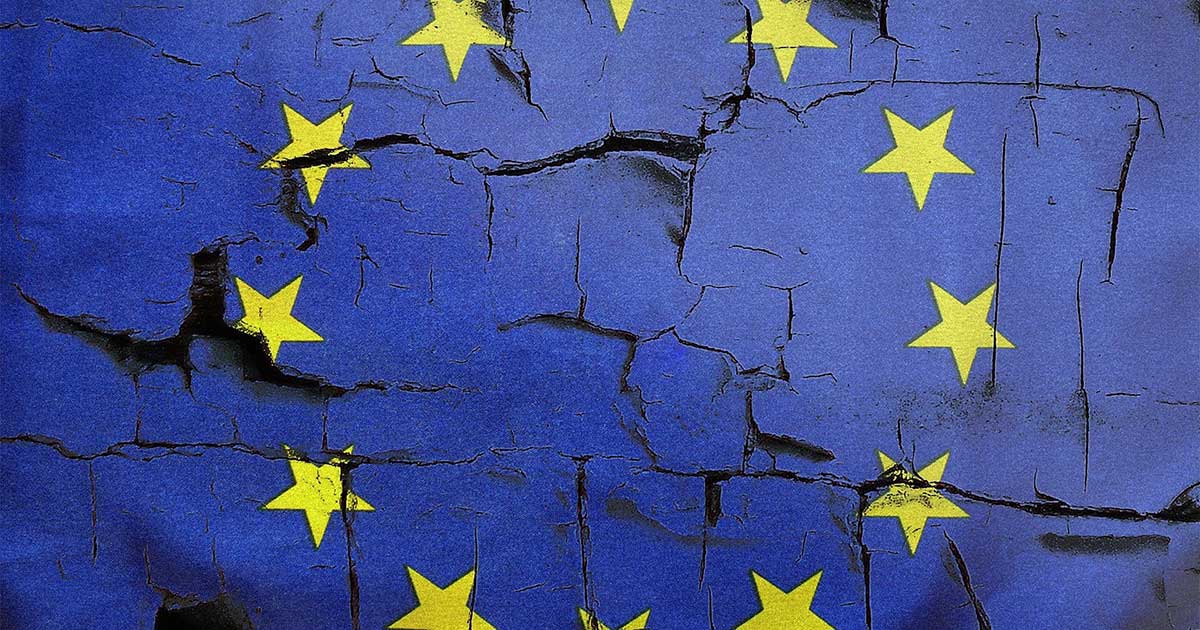
Given that, until recently, the compatibility of its peacekeeping and social components was the European Union’s defining characteristic and comparative advantage, it appears that, of all aspects of the EU’s current accelerated militarization, its financial dimension is now the most significant. The financial data surrounding the Union’s militarization speaks most eloquently of its tectonic transformation and most effectively dispels the misconceptions about the positive financial effects of Serbia’s membership in the EU—misconceptions that stem from an outdated, utopian perception of the Union that bears little resemblance to the new reality.
THE RAPID RISE IN DEFENSE BUDGETS
According to Eurostat data, the member states of the European Union had been following a trend of reducing their defense budgets until 2014. From Russia’s annexation of Crimea until 2022, there was, for the first time, a continuous but gradual increase in military budget allocations, with the aim of reaching the then projected maximum of 2% of GDP. With the outbreak of the war in Ukraine, as well as the crisis in the Euro-Atlantic partnership during Trump’s second term, a trend emerged of dramatic and unrestricted increases in state defense spending (exceeding 5% of GDP).
As a result, the total real increase in the military budgets of all European Union member states between 2015 and 2025 amounted to as much as 99%. Furthermore, between 2020 and 2025, defense expenditures of EU member states increased in real terms by as much as 63%. Looking at individual medium-sized and smaller EU member states from different parts of Europe, the increase in defense spending between 2014 and 2024 was as follows: Bulgaria allocated $747 million to defense in 2014, and $2.3 billion in 2024; over the same period, the Czech Republic increased its defense spending from $1.9 billion to as much as $6.8 billion; Denmark raised its defense budget from $4 billion in 2014 to $9.9 billion in 2024; Lithuania increased military spending from $428 million in 2014 to $2.3 billion in 2024; Hungary increased its defense budget from $1.2 billion in 2014 to as much as $4.8 billion in 2024; Romania increased military spending from $2.3 billion in 2014 to $5.4 billion in 2024; and tiny Luxembourg increased its defense expenditures from $253 million in 2014 to $785 million in 2024.
Although five European Union member states—Germany, France, Italy, Poland, and Spain—account for around 70% of the total defense spending of all EU members, the amounts allocated by several medium-sized and smaller member states are by no means insignificant and far exceed Serbia’s military expenditures. In 2024, Serbia’s military budget amounted to only about $2.4 billion. Moreover, data showing that Austria’s military budget reached $4.9 billion in 2024 demonstrates that the accelerated militarization of European Union member states is not always directly linked to NATO membership, since Vienna is not a formal member of the Western military alliance.

MARK RUTTE: SACRIFICE YOUR PENSIONS AND HEALTHCARE
The differences between Serbia and certain medium-sized and smaller EU member states become even more pronounced when annual military spending per capita is compared. Let us take 2025 as an example, when Serbia’s military budget amounted to $2.7 billion, or approximately $414 per capita. In the same year, according to NATO data, defense spending per capita amounted to $1,019 in Lithuania, $2,416 in Denmark, $637 in Slovenia, $651 in Greece, $453 in Croatia, $546 in Portugal, and as much as $3,026 in Norway, which by this measure became the first European country to surpass the United States.
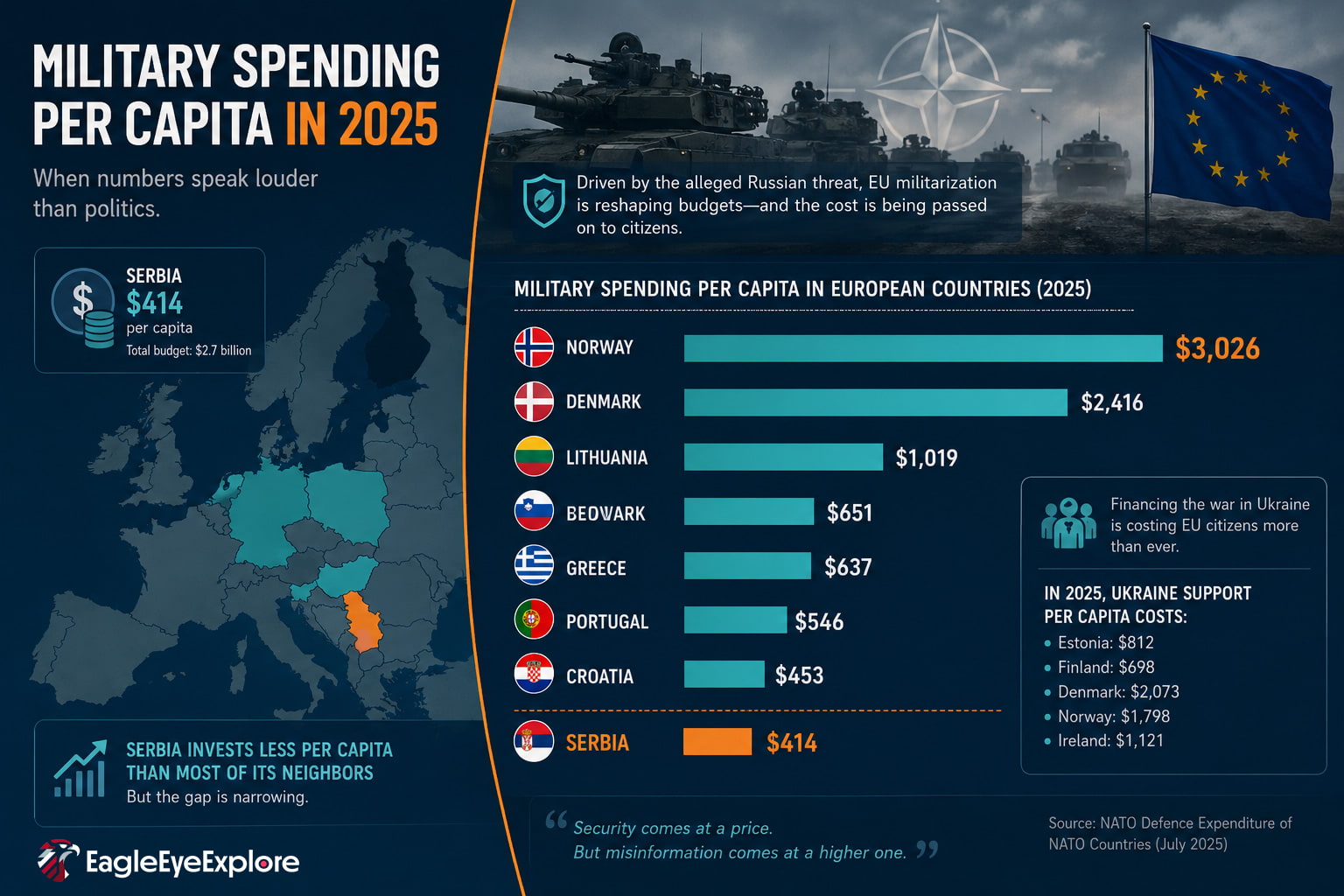
The financial dimension of the European Union’s militarization, justified by the alleged Russian military threat, is also linked to the participation of the Union and its member states in financing the Kyiv regime and the proxy war that the West is waging against Russia in Ukraine. The funds allocated for this purpose by certain EU member states in 2025—particularly the Nordic and Eastern European members—far exceeded the amounts contributed by the United States. Thus, financing Ukraine’s war against Russia in 2025 cost the citizens of Estonia $812 per capita, Finland $698, Denmark $2,073, Norway $1,798, Ireland $275, Croatia $105, while the United States spent only $377 per capita.
That the militarization of the European Union and its transformation into a military bloc are incompatible with preserving the Union’s former social model—even in its wealthier member states—was also confirmed by Finnish Prime Minister Petteri Orpo. As reported by Reuters, Finland will increase defense spending to 3.2% of GDP by 2030, despite the fact that the country has been facing a growing budget deficit for several consecutive years (reaching 4.3% in 2025). Moreover, Prime Minister Orpo openly announced that, as a consequence of the country’s accelerated militarization, government spending on healthcare and social services would have to be reduced.
Furthermore, NATO Secretary General Mark Rutte once directly called on citizens of European Union member states to “sacrifice” their pensions and healthcare in order to increase government investment in defense. According to Ursula von der Leyen, a “new fiscal space” must urgently be found to finance the rearmament of the European Union.
THE TWILIGHT OF THE IDEA OF PROSPERITY
In order to implement the ambitious plan for the militarization of the European Union—which, among other things, envisages total defense investment by all EU member states reaching at least €800 billion by 2030 (compared to total defense investments of €102 billion in 2024)—member states could, at best, secure the planned funds by reducing expenditures on social services, healthcare, education, and culture, as well as on regional development, innovation, and industrial subsidies (in November 2025, the EU had already adopted a decision allowing the reallocation of funds from civilian to military programs). They could also do so by increasing taxes, as well as by increasing budget deficits for defense purposes through the activation of the escape clause, thereby bypassing the fiscal deficit rules established under the EU’s Stability and Growth Pact.
This method of financing the planned investments in defense and the defense industry, which will ultimately transform the common perception of the European Union as a “realm of prosperity,” is entirely understandable in the context of the deep financial crisis that EU member states have been facing ever since they embarked on a policy of radical confrontation with Russia and the related process of militarization.
Although the EU’s fiscal rules limit budget deficits to 3% of GDP, the deficit reached 3.2% in 2024 and 3.3% in 2025, while the budget deficits of certain member states were even higher—for example, 8.7% in Romania, 8.5% in Poland, and 5.4% in France. Likewise, although the Union’s fiscal rules stipulate that total public debt should not exceed 60% of GDP, by 2025 it had reached a record 83.2% across the EU. During the period of the Union’s accelerated militarization and its most radical confrontation with Russia, the EU’s share of global GDP declined from 17% in 2011 to 14% in 2025.
CENSORSHIP AS A PATH TO BRAINWASHING
Before the emergence of the Russophobic cancel culture, which became the justification for widespread media censorship and the imposition of political conformity across the West—primarily in the European Union and the United Kingdom—even leading Western globalist publications such as London’s The Guardian published articles expressing doubt that it would be possible to preserve the European Union’s original peaceful and social character under conditions of militarization. After four years of continuous campaigns of intimidation and “brainwashing,” the majority of citizens in Austria, Bulgaria, Denmark, Estonia, France, Germany, Hungary, the Netherlands, Poland, Portugal, Spain, Sweden, Switzerland, and the United Kingdom—with the exception of Italy—now support the official course of militarization, without considering the consequences of this dangerous policy, which could easily threaten not only their wallets but also their lives.
If, in the words of Sergei Karaganov, the citizens of the European Union—especially those of the so-called “Old Europe”—have lost their fear of a major war, Serbs should continue to feel that life-preserving fear of a great catastrophe, having emerged from numerous wars only two and a half decades ago. Consequently, it is time for even the greatest Euro-enthusiasts among us—unless they are professional admirers of the European Union—to realize that every further step Serbia takes toward European integration brings it closer not only to a military bloc that has long ceased to be a peace and social project, but also to a major European war.