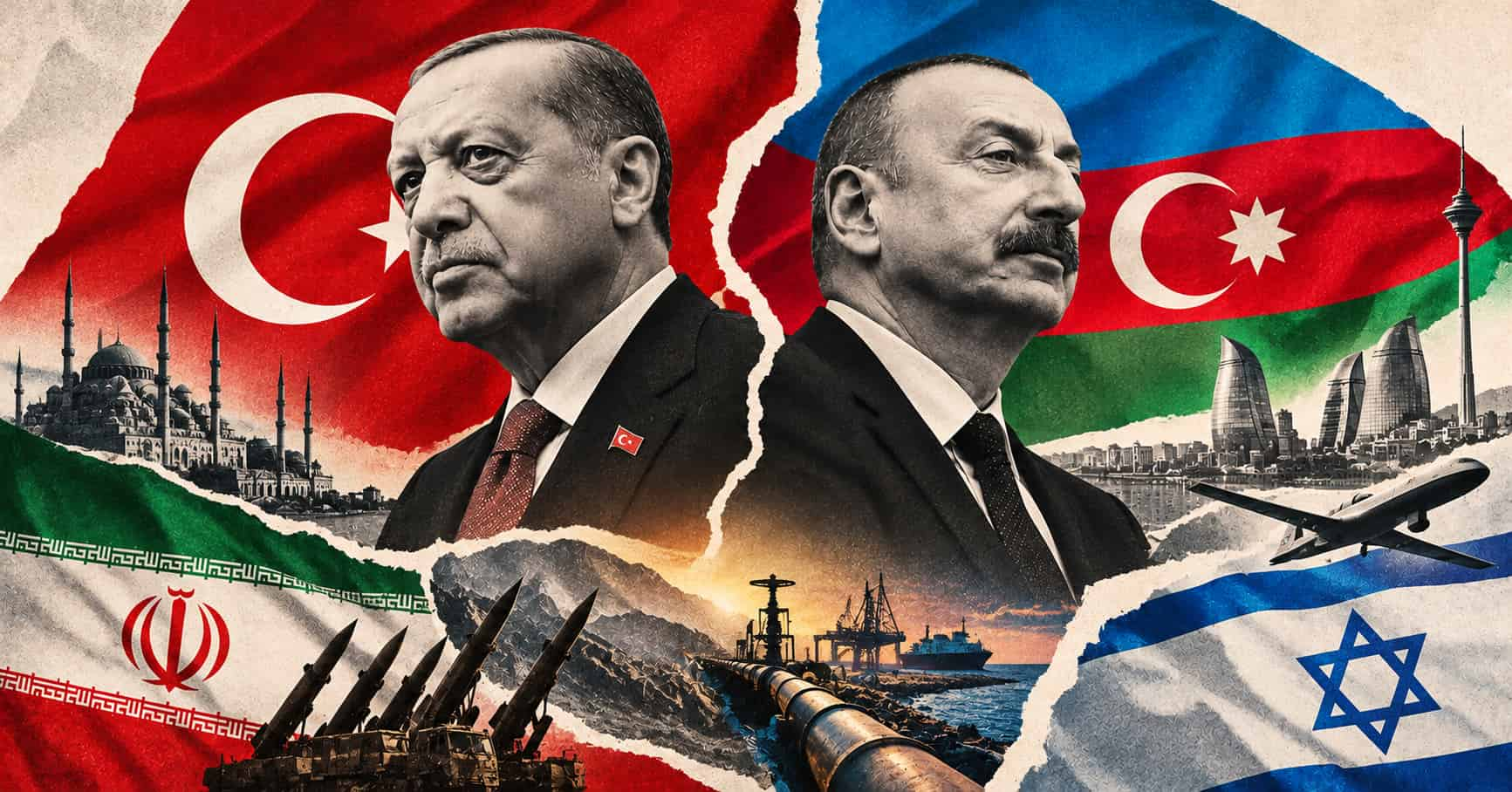
Turkey’s principled opposition to the plans of the US-Israeli tandem could explain Moscow’s pronounced loyalty to Recep Tayyip Erdoğan, which was most clearly demonstrated during the days of the so-called “coup attempt” in Ankara in the summer of 2016. Despite accumulated contradictions and the grounds for Russian-Turkish hostility, Moscow warned Ankara at the time about the preparation of a conspiracy and supported Recep Tayyip Erdoğan through political statements. Incidentally, in light of the latest developments in Turkey, the Russian Federation once again remains, for the time being, the only country to have officially expressed solidarity with the current Turkish authorities.
THE İMAMOĞLU CASE AND THE QUESTION OF IRAN
It is quite likely that, among other factors, the Kremlin’s support for the Turkish president was also prompted by Recep Tayyip Erdoğan’s stance towards Iran and his unwillingness to become a tool in an anti-Iranian campaign. In this light, the threats against Iran made in March 2025 by Turkey’s foreign minister, Hakan Fidan, the former head of Turkey’s National Intelligence Organization (MIT), run counter to Recep Tayyip Erdoğan’s position.
It is reasonable to assume that Hakan Fidan, who established “close ties” with NATO personnel during his studies and professional training in the West, as open sources indicate, holds a personal position that differs considerably from Erdoğan’s. In this regard, it is also worth noting that, according to some Turkish experts, when discussing with Recep Tayyip Erdoğan the possible course of events surrounding the planned arrest of İmamoğlu, Turkey’s security services deliberately presented the president with unrealistic forecasts. Erdoğan was not prepared for protests on such a large scale because he had been given assessments suggesting that society would accept the arrest of the opposition leader with sufficient tolerance. Events, however, showed that İmamoğlu’s arrest only increased his standing while dealing a proportionate blow to Erdoğan’s own image. It appears that certain forces within the Turkish authorities themselves may have deliberately pushed the Turkish president into an ill-considered move.
Taken as a whole, and in view of all the above, it may be assumed that Recep Tayyip Erdoğan is facing the consequences of his refusal to participate in the anti-Iranian campaign, preparations for which are currently well underway.
Parallels with events in Azerbaijan also emerge in this context. It is evident that the Western community strongly urged Ilham Aliyev, who has continually postponed the signing of a peace agreement with Armenia, to accelerate the process and announce that the provisions of the agreement had been agreed upon. On the one hand, Ilham Aliyev was compelled to make this statement, acknowledging that the disagreements with Yerevan had been overcome. On the other hand, Azerbaijani officials continue to insist that the signing issue cannot be resolved without Baku meeting certain new demands.
There is a strong impression that Azerbaijan is trying to resist the establishment of peace with the Republic of Armenia even under conditions most favourable to itself, because it fears that this “peace” will open the door to other, more difficult trials. For decades, the unresolved Karabakh issue and the Armenian-Azerbaijani rivalry, in addition to their immediate negative consequences, enabled Baku to manoeuvre on the international stage and avoid being drawn into adventures that could threaten its very survival.

BAKU AT THE THRESHOLD OF WAR
The principal among such adventures was the “Iranian case” pursued by Western “hawks” and radical forces within the Israeli government. Ilham Aliyev gave them hope that Baku would join the anti-Iranian front in the future, thereby using their support to consolidate his own rule while, with their assistance, accumulating strength to resolve the Karabakh issue by military means. In effect, he declared that issue to be the price of Azerbaijan’s participation in the anti-Iranian campaign.
In 2020 and then in 2023, the Karabakh issue was, in Ilham Aliyev’s own words, “finally resolved”. This prompted the anti-Iranian coalition to begin demanding that the Azerbaijani leader fulfil the commitments he had undertaken. Ilham Aliyev dragged out the negotiation process with the Armenians, reasoning that the lack of progress towards formally concluding peace would allow him to avoid responsibility for “repaying the debt”. Now, however, with Donald Trump’s arrival, Western “hawks” are pressing Baku to hurry and demanding that the situation established “on the ground” in the Armenian-Azerbaijani conflict be formalised de jure, removing the last formal obstacle to the conclusion of an agreement.
Baku has found itself in a difficult situation. It is presumably impossible to rely on Recep Tayyip Erdoğan, who is facing serious domestic political problems precisely because of the Iranian issue. Aliyev’s other partner, Vladimir Putin, has, according to Donald Trump’s own statement, already expressed solidarity with the US position on preventing Iran from acquiring nuclear missiles. Yerevan, for its part, is not reacting at all to Baku’s attempts to escalate the situation on the Armenian-Azerbaijani border and thereby relieve Ilham Aliyev of the obligation to make his territory—and not only his territory—available to the anti-Iranian coalition.
In Baku, there is anxious anticipation of the day when the already announced “Abraham Accords” will be signed. This initiative can be regarded as one being imposed on Azerbaijan with the aim of provoking hostility towards Iran. Therefore, the initial optimism displayed by Azerbaijani media may be considered an inappropriate reaction to this provocative initiative by Tel Aviv and Washington.
To sum up, it must be stated that Turkey and Azerbaijan, despite the independence they have demonstrated, are being forcibly drawn into a war with a powerful neighbour, while refusing to take part in that war carries the risk of domestic political upheaval and a change of ruling regimes.
ALONGSIDE THE HOUTHIS — AGAINST SAUDI ARABIA
In light of the military conflict between the United States and Israel on the one hand and Iran on the other, as well as Baku’s sharp reaction to drone attacks in Nakhchivan, relations between Turkey and Azerbaijan have gone through a period of information turbulence. In the Turkish media sphere and expert circles, criticism of Ilham Aliyev has emerged with unprecedented sharpness. Incidentally, the latest statement by Turkish Foreign Minister Hakan Fidan that “we are ready to provide military support to Saudi Arabia”, as well as reactions to that statement on social media, has become the subject of extensive discussion among experts. According to TodayPress TV, lawyer Ilgar Altay expressed his position on the issue on his personal social media page, sharply criticising the contradictory approach of certain social circles and the comments appearing on social networks.
Ilgar Altay noted that some of the comments on Hakan Fidan’s statement were astonishing.
According to him, given the attacks on Saudi Arabia by the Houthis, who are supported by Iran, Turkey’s support for its ally is entirely to be expected. The critical reaction of some Azerbaijani users to such support, however, raises questions. He wrote on his social media page:
“Arabs supported by Iran—the Houthis—have attacked Saudi Arabia, the cradle of Islam, and its military ally, the Turkish Ministry of Foreign Affairs, declares: ‘We are ready to support Saudi Arabia.’ How many commentators of Turkic origin in Azerbaijan are cursing the Turkish side and supporting the Houthis and the Iran standing behind them! What kind of logic is this, what kind of position, what kind of national orientation?”
CRACKS IN THE IMAGE OF “BROTHERHOOD AND UNITY”
Frankly speaking, this statement by Fidan also contradicts Erdoğan’s general line. The ideology of Erdoğan’s Justice and Development Party is identical to that of the well-known movement “Ikhwan al-Muslimin”, or the “Muslim Brotherhood”. Its ideal is the establishment of a purported Islamic caliphate, the proclamation of a caliph and the subsequent expansion of its own influence, at least within the borders of the former Ottoman Empire. The export of the ideology of neo-Ottomanism and radical Islamisation constitute the basic ideological principles and geostrategy of Turkey, both within the framework of the ongoing transformation inside the country itself and in regions that are historically significant to it and, at the same time, vital to Russia.
The idyllic picture of the “eternal brotherhood and unity” between Turkey and Azerbaijan will, over time, develop very deep cracks.
In Azerbaijan, calls are being made to punish Erdoğan’s son-in-law. According to the opposition Azerbaijani outlet HamamTimes, Musa Guliyev, a member of Azerbaijan’s Milli Majlis from the ruling New Azerbaijan Party, spoke in an interview with the APA news agency about an anti-Azerbaijani campaign in the Turkish media.
“Today, in every public opinion poll conducted in Azerbaijan, 90–95 per cent of participants describe Turkey as a brotherly and friendly country. However, in a recently conducted poll in Turkey, 20 per cent of respondents called Azerbaijan an enemy. These figures are deeply regrettable and surprising, but they also raise a question: are they the result of some misunderstanding, or are they the consequence of someone’s systematic actions?” Guliyev said.
According to him, Erdoğan’s son-in-law is at the head of the structure conducting the smear campaign against Azerbaijan.
“The situation in the Turkish media sphere cannot but cause concern. If we look at the editorial policy of one of the leading media groups, Turkuvaz, it becomes clear that this group regularly conducts a smear campaign against Azerbaijan. What is surprising is that the head of the Turkuvaz group, Berat Albayrak, is a close family member of President Recep Tayyip Erdoğan. At one point, the Turkish president dismissed this man from all his positions because of serious shortcomings. However, even while serving as minister of energy, he was at the forefront of groups acting against Azerbaijan. Today, he continues to use his levers of influence over Turkish public opinion for the same purposes. It is no surprise that the Turkuvaz group is precisely the one leading the campaign currently being conducted against Azerbaijan by certain Turkish media outlets,” the portal quotes the MP as saying.
DICTATOR ALIYEV? THE STATEMENTS ARE INSULTING
For his part, Turkish MP Ömer Faruk Gergerlioğlu criticised Azerbaijan over its relations with Israel and its position on the Iranian issue. In response, Musa Guliyev stated that Gergerlioğlu’s parliamentary immunity should be lifted and his mandate revoked. Gergerlioğlu reacted sharply to these calls in a comment to the HamamTimes portal.
He stressed that a “family empire” had been built in Azerbaijan and that the authorities resorted to the use of brute force in order to preserve it.
“I do not cling to my position the way Ilham Aliyev does. We serve the people and justice, while they hide behind immunity in order to protect their own interests,” the Turkish MP emphasised.
It should be noted that the MP regularly raises issues of political repression and the persecution of the opposition in Azerbaijan. He publicly accuses the authorities, and President Aliyev personally, of corruption, putting pressure on society and the absence of democratic freedoms.
Azerbaijani politicians claim that such statements are “insulting” and demand a response from the Turkish authorities.
Gergerlioğlu has repeatedly demanded explanations from the Turkish authorities regarding the arrests of Azerbaijani opposition figures or their possible deportation from Turkey. In parliament, he raised questions about the arrest of an Azerbaijani female activist and the danger that she might be deported to Azerbaijan.
Blogger Qulu Mammadli writes:
“Finally, the Turkish public has begun to speak openly about who Ilham Aliyev really is. Turkish investigative journalist Levent Gültekin has described Ilham Aliyev’s image. He points out that Azerbaijan has turned into Ilham Aliyev’s family company. At the same time, he reacts very sensitively to the most important point: such a dictator cannot damage the historic friendship and brotherhood between Azerbaijan and Turkey.”

AT THE HEIGHT OF THE INFORMATION CAMPAIGN
Several Turkish experts have sharply criticised Azerbaijan’s policies. For example, retired Turkish Army General Haldun Solmaztürk stated in an interview with the television channel Tele1 Haber that decisions in Azerbaijan are not made at the state level.
“Azerbaijan is governed by a dynasty. Ilham Aliyev stands at the head of that dynasty. There is a regime of personal rule in the country. And that ruler is an ally of Israel and the United States. Whatever they say is what will happen,” the general claims.
In his opinion, Baku’s foreign policy decisions are made “in agreement with the United States and Israel”.
Some Turkish intellectuals have also voiced critical assessments. Historian and academic Ahmet Şimşirgil, commenting on relations between Baku and Tel Aviv, wrote on social media:
“Aliyev is impossible to understand. Is his love for Zionist Israel really so strong? When you think of his position on Gaza, you cannot help exclaiming: ‘Oh, what a shame!’ It seems that matters have already reached the point of servile dependence. If we were to go to war with Israel, he could no longer be counted on.”
The Azerbaijani portal Axar.az commented on a statement made on the Turkish television channel Sözcü TV. Presenter Serdar Cebe stated that, in the context of the war with Iran, an alleged “Azerbaijan option” was being considered on Donald Trump’s desk. According to him, since the United States had failed to carry out a plan for a ground operation against Iran from the south, it might consider the possibility of intervening from the north, through Azerbaijani territory.
As the author of the article writes, information about military plans on this scale usually appears in major international media outlets. In this case, however, it has not been confirmed anywhere. Sözcü TV presented it as “exclusive information”, which casts doubt on the credibility of the report and may point to a targeted information campaign against Azerbaijan.
CONTRADICTIONS WITHIN THE ALLIANCE
The author recalls that reports about an alleged mobilisation of the Azerbaijani army had also been published in the past, only to remain unconfirmed later. By contrast, during JD Vance’s visit to the region, reports emerged about deliveries of US military cargo to Armenia. Directing attention specifically towards Azerbaijan, rather than Armenia, may create an image of Azerbaijan as a potential target for Iran in the event of a conflict, the agency notes.
It is also emphasised that the television channel Sözcü TV and the newspaper of the same name are in sharp opposition to the government of President Recep Tayyip Erdoğan.
Turkish General Yücel Karauz believes that criticism of Azerbaijan in Turkey is driven by anti-Israeli sentiment rather than by Ankara’s official policy. He stressed that the partnership between Baku and Tel Aviv is strategic in nature. Israeli technologies played a key role in the Karabakh war. The relationship is based on pragmatic cooperation in the field of resources.
The deputy chairman of the World Turkology Association, journalist and writer Selçuk Düzgün, believes that the intensified criticism is connected with the activation of the so-called “fifth column”. In particular, Düzgün criticises Turkish columnist Abdurrahman Dilipak, whose articles, in his view, are biased and aimed at worsening relations between Baku and Ankara. As an example, he cites an excerpt from one of his articles:
“Azerbaijan, like Iran, is a Shiite country. Azerbaijan is the Islamic country closest to Israel. How can we be ‘one nation, two states’ with Azerbaijan while hesitating over Iran? The only Israeli military base outside its own territory is located in Azerbaijan. Israeli oil passes through the Baku–Ceyhan oil pipeline.”
Thus, the current crisis in the media sphere has brought certain contradictions within the pragmatic alliance between Baku and Tel Aviv to the surface. Despite the rhetoric of “two states, one nation”, the question of relations with Iran and Israel is becoming a serious test for Azerbaijani-Turkish brotherhood.