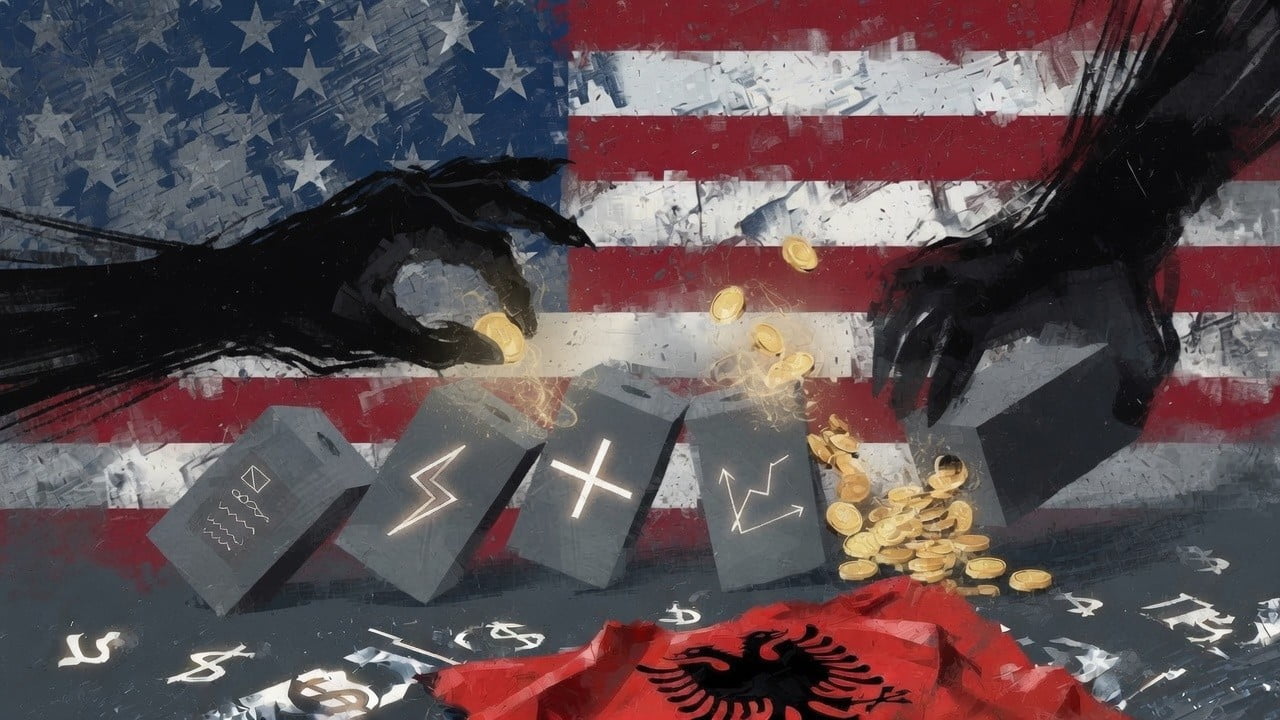
Thirty years of American aid penetrated the Albanian state more deeply than anywhere else in the Balkans: courts, the prosecution service, organizations monitoring public policies, and media newsrooms were funded. In 2025, funding was suspended within just six weeks. By the summer of 2026, the prosecution service built with American support had been investigating legal and property transactions connected to an investment project supported by the son-in-law and daughter of the President of the United States, while Tirana had entered the seventh week of protests demanding the resignation of the prime minister.
On the morning of January 21, 2026, a convoy of SUVs, accompanied by a police escort, passed through the coastal villages of southern Albania. In one of the vehicles, according to the Balkan Investigative Reporting Network (BIRN), was Ivanka Trump. She visited the Vjosa-Narta Lagoon, visited the Monastery of Saint Mary, and had dinner twice with Prime Minister Edi Rama. Just a few months later, the investment project connected to that visit became the cause of mass protests, while two separate investigations began to intersect with the project itself. These events simultaneously raised a question that Tirana had previously avoided asking publicly: what was the actual purpose of thirty years of American presence?
The answer can be found more readily in figures, contracts, and court rulings than in debates about political influence: what was built in Albania with American money, why funding was terminated at the beginning of 2025, and what has since filled the space it left behind.
THIRTY YEARS AND HALF A BILLION DOLLARS
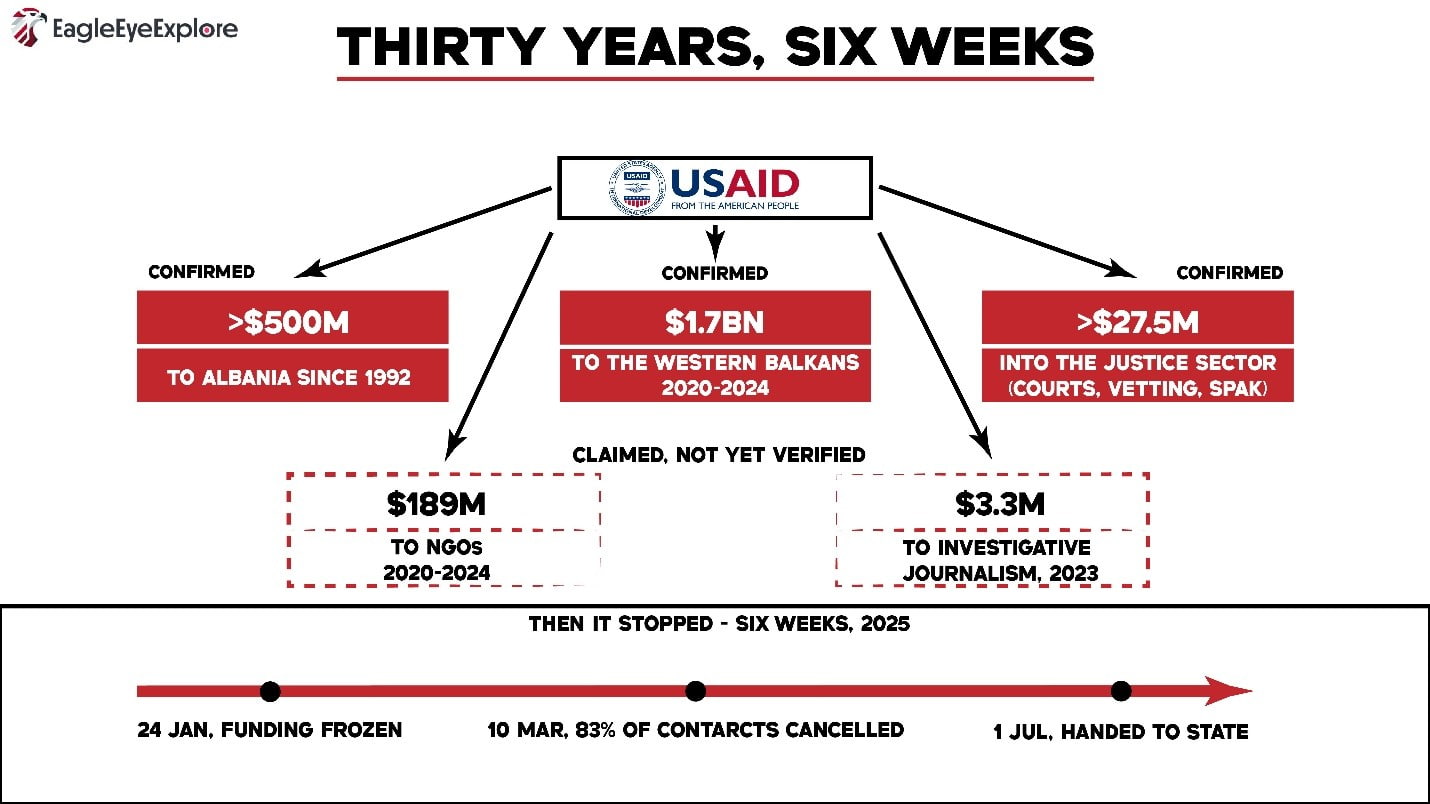
Since 1992, the United States Agency for International Development (USAID) has directed more than half a billion dollars to Albania, according to the agency’s own officially published data. The funds were intended to develop political pluralism and civil society, independent media and the rule of law, as well as the energy, healthcare, and market economy sectors. The framework agreement on development objectives, first ratified at the end of 2013, was extended several times. With the latest extension, the total value of the funding was increased to $97 million, and its duration was extended until 2030. The signing ceremony was held at the United States Embassy in Tirana, in the presence of the Minister of Finance and the director of the USAID mission.
Albania was only part of the broader regional picture. Between 2020 and the end of 2024, the United States invested approximately $1.7 billion in six Western Balkan countries. Announcing the freeze on aid, U.S. presidential envoy Richard Grenell presented figures for funds that he said had been allocated to non-governmental organizations in five countries of the region over a four-year period: $537 million to Kosovo, $402 million to Bosnia and Herzegovina, $290 million to North Macedonia, $209 million to Serbia, and $189 million to Albania. However, these figures require some caution, as they stem from a political statement rather than an official budget database, and should therefore be considered separately from the total amount of $1.7 billion.
One item is of particular importance here – the financing of journalism. According to data cited by the China-CEE Institute, at least $3.3 million was invested in investigative journalism in Albania during 2023 alone. By comparison, that is approximately twice the total reported spending on the election campaigns of the country’s two largest political parties. However, based on publicly available sources, it is difficult to determine precisely where that money ended up, because USAID’s public reports are incomplete.
HOW THE JUDICIAL SYSTEM WAS BUILT
The largest American investment in Albania was neither poverty-reduction programs nor road construction. It was the judiciary. It was precisely in this area that the American presence penetrated most deeply into the state apparatus, and what was built at the time is today the subject of the sharpest political disputes. This story only makes sense if the different American institutions are examined separately – something most other analyses and reports do not do.
TWO HANDS OF ONE GOVERNMENT
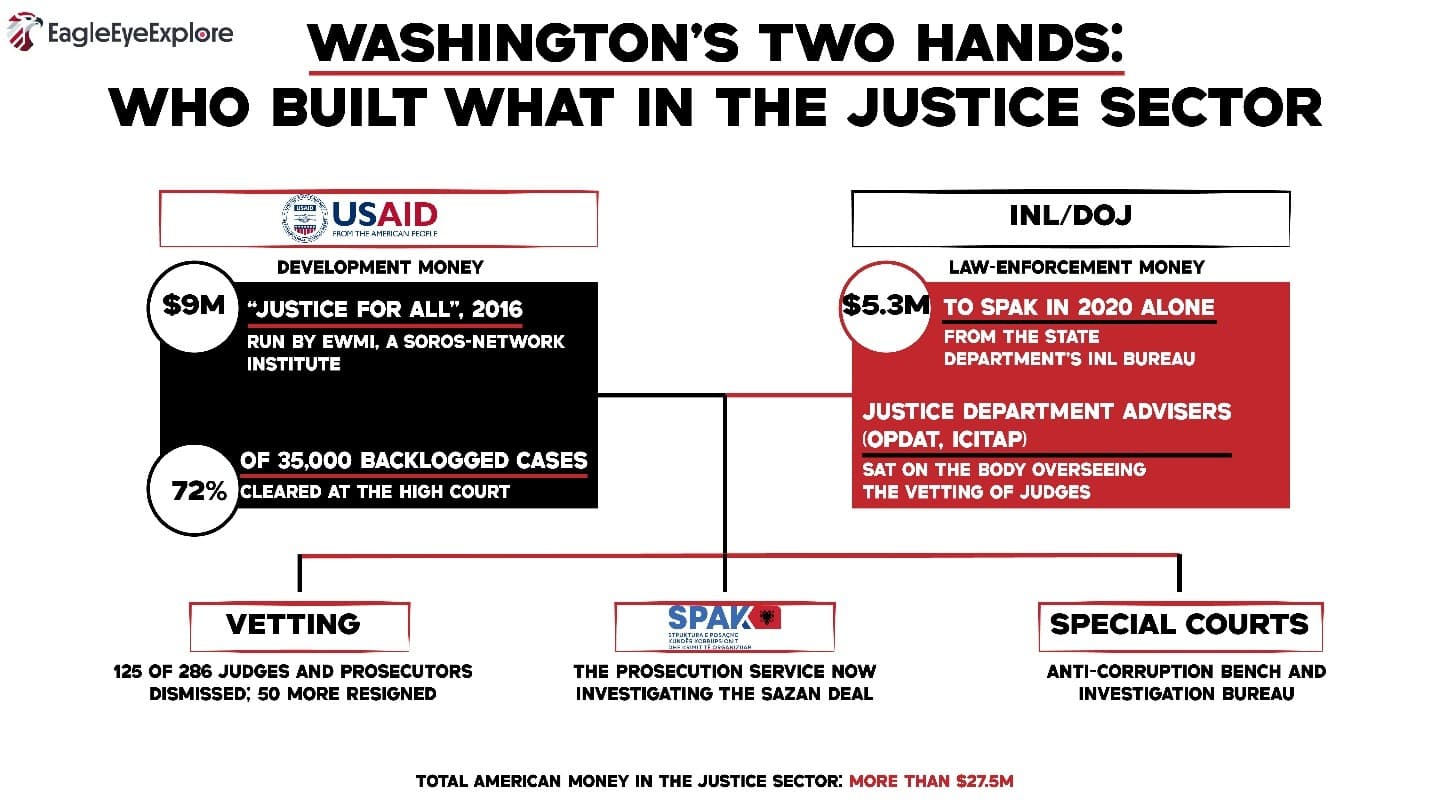
The “softer hand” was represented by USAID. Its flagship project, Justice for All, received nine million dollars in 2016, according to data cited by the China-CEE Institute, which referred to an American publication. The project was implemented by the East-West Management Institute, an organization associated with the Open Society network. USAID later launched the Transparency Academy, an institute whose goal was to promote open government and judicial accountability. Thanks to USAID programs, the Supreme Court of Albania reduced its accumulated backlog of unresolved cases: according to official data, 72 percent of approximately 35,000 outstanding cases were prioritized and resolved.
The “harder hand” was represented by the State Department and the United States Department of Justice. The Bureau of International Narcotics and Law Enforcement Affairs (INL) funded the process of vetting judges and prosecutors, while an adviser from the OPDAT office was a member of the international body overseeing the process. The establishment of the Special Prosecution Against Corruption and Organized Crime (SPAK) and the National Bureau of Investigation (BKH) was supported by OPDAT and ICITAP, a U.S. Department of Justice program. In 2020 alone, INL allocated $5.3 million to SPAK. According to data from the U.S. Embassy in Tirana, more than $27.5 million in total American aid was invested in the reform of the Albanian judiciary.
However, it should be noted that a significantly larger amount also appears in public discourse – $270 million over fifteen years. That figure comes from a politically oriented source and cannot be reconciled either with the official figure of more than half a billion dollars in total American aid to Albania, or with the much smaller amount cited by the U.S. Embassy as funds intended for judicial reform. The difference between “$27.5 million for the judiciary” and “$270 million” in itself demonstrates how often these figures are cited without sufficient precision.
A PROSECUTION SERVICE WITHOUT A COUNTERWEIGHT
The judicial reform of 2016 was presented as a radical break with a judicial system burdened by corruption and political pressure. The process of vetting judges and prosecutors gradually turned into a mass purge. According to official data from 2020, of the 286 judges and prosecutors who underwent the vetting process, 125 were dismissed due to unexplained origins of wealth, ties to organized crime, or incompetence, while another 50 officials resigned in order to avoid the process itself. Critics claim that more than half of the judges and prosecutors were ultimately removed, and that the ruling party filled the resulting vacuum by appointing politically loyal personnel.
Today, critics consider SPAK to have grown into an exceptionally powerful institution based on the dominance of the prosecution, with limited democratic oversight, and that its powers are applied in accordance with political circumstances. High-profile cases from the 2024–2026 period have further fueled this debate. Former President Ilir Meta has been in detention since October 2024 and is currently on trial, while his arrest prompted accusations of political persecution. The proceedings against Fredi Beleri, the mayor of Greek ethnicity, raised concerns among organizations dealing with the rights of national minorities. Erion Veliaj, the mayor of Tirana, has been in detention since February 2025. On November 3, 2025, the Constitutional Court annulled his dismissal and formally reinstated him as mayor, but he remains in prison, while the capital is in practice governed by his deputy. Deputy Prime Minister Belinda Balluku faces allegations of rigging public tenders, but the Socialist majority in parliament blocked her arrest.
In the spring of 2026, Prime Minister Edi Rama announced a legislative proposal that would prevent courts from removing ministers from office while they are under criminal investigation. As reported by Reuters, the opposition described the proposal as a blow to judicial independence and a mechanism for protecting the prime minister’s associates, while Rama accused judges of exceeding their powers. The system that had been built over more than a decade as an institutional counterweight to political power had, by 2026, itself become the subject of a political struggle between elected officials and judicial institutions that were supposed to oversee them.
Doubts about the results of these reforms are increasingly being voiced in Washington itself. At a hearing of the Subcommittee on Europe of the U.S. House Foreign Affairs Committee in December 2025, its chairman, Keith Self, stated that after ten years of implementation, it was justified to ask whether the reform of the Albanian judiciary had truly delivered the expected results – a reform that had been financed precisely by the United States.
A VERDICT INSTEAD OF SPECULATION: THE MCGONIGAL CASE
Discussions about American institutions becoming intertwined with local centers of power most often remain at the level of assumptions. In the Albanian case, however, there is one exception: an event that was confirmed by a U.S. court ruling.
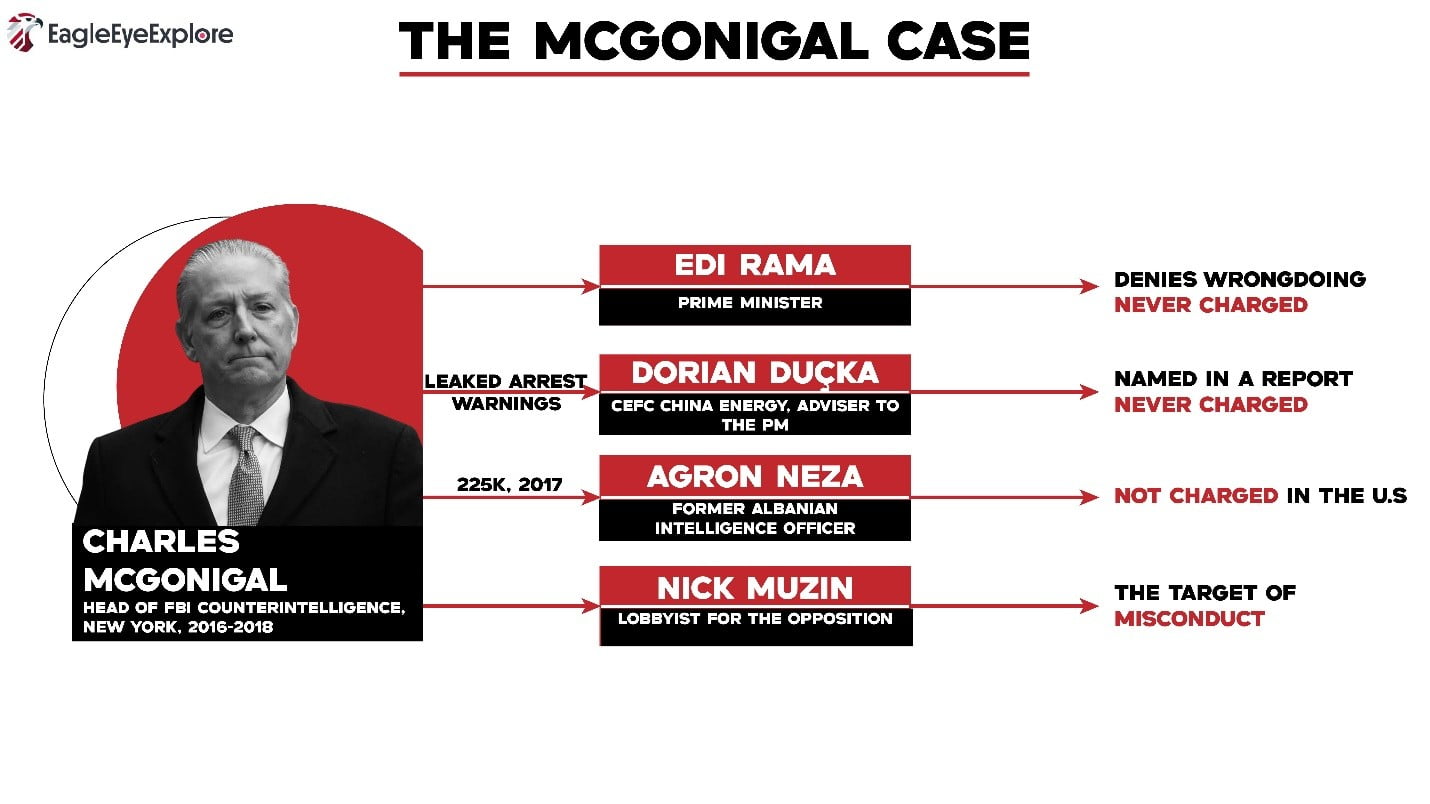
Charles McGonigal headed the counterintelligence division of the Federal Bureau of Investigation (FBI) in the New York office. From August 2017 until his retirement in September 2018, he was responsible for counterintelligence and national security matters. On September 22, 2023, he pleaded guilty to concealing materially significant facts: he concealed from the Federal Bureau of Investigation that he had received at least $225,000 in cash from a former foreign intelligence officer who had business interests abroad, that he had traveled abroad with him, and that he had met with foreign nationals, in part to advance their private business interests. In a statement from the U.S. Department of Justice, this person was described as an individual connected to the Government of Albania, while court records and media reports identified the person as Agron Neza, a former Albanian intelligence officer living in New Jersey.
According to the court case, between September 2017 and June 2018, McGonigal submitted forms to the FBI in which he falsely represented and concealed his travels and contacts. He did not identify his travel companion, did not report the countries he had visited, falsely represented the purpose of the trip, and stated that he would have no contact with foreign nationals, even though he had planned such meetings and actually held them. On September 7, 2017, he traveled to Albania, where he met with several foreign nationals, including the Prime Minister of Albania. In one instance, acting on information originating from the Albanian prime minister’s circle, McGonigal initiated a criminal investigation in New York against an American lobbyist who worked for an Albanian opposition party.
The details of this case reveal a recognizable pattern. Lobbyist Nick Muzin subsequently registered his work for the Democratic Party of Albania under the U.S. Foreign Agents Registration Act. On November 22, 2017, the Balkan Investigative Reporting Network (BIRN) reported that $500,000 had been paid for that engagement, and just three days later McGonigal reported to the Department of Justice a “possible criminal investigation” into the same lobbyist. On February 26, 2018, the Federal Bureau of Investigation officially opened an investigation, precisely at McGonigal’s initiative. The New York Times also reported that McGonigal helped a company connected to Neza obtain a permit to exploit oil, as well as attempting to secure a $500,000 payment to Neza from an Eastern European pharmaceutical company.
The epilogue to this case is documented in court records. In December 2023, McGonigal was sentenced in a separate case to 50 months in prison for working for sanctioned Russian oligarch Oleg Deripaska. In February 2024, he received an additional 28-month prison sentence for concealing payments connected to Albania, with the judge ordering the sentences to be served consecutively, bringing the total to approximately six and a half years in prison. The court specifically found that his conduct significantly obstructed the administration of justice. Then, in September 2025, an Inspector General’s report found that McGonigal, beginning in June 2017, provided Dorian Duçka – an employee of the Chinese company CEFC China Energy and an informal adviser to Edi Rama – with confidential information about impending arrests in a case involving CEFC.
Edi Rama rejects all allegations of any wrongdoing, and he has never been indicted in Albania. Nevertheless, the court record shows that McGonigal became involved in intertwined relationships with a former Albanian intelligence officer and an informal adviser to the Albanian prime minister, while simultaneously using his official position to pursue private interests. Such a conclusion is not based solely on assumptions, but on court records, findings of the United States Department of Justice, and the Inspector General’s report.
HOW EVERYTHING WAS SHUT DOWN IN SIX WEEKS
At the beginning of 2025, the funding system that had been built over three decades was practically brought to a halt overnight. On January 24, the State Department ordered a freeze on new funding for almost all foreign aid programs. The United States Embassy in Tirana sent a letter to Albania’s Ministry of Foreign Affairs listing at least thirty institutions affected by the decision – including courts, prosecutors’ offices, and the ministries of defense, education, and finance, as well as the financial intelligence agency. Only activities completed before January 27 were eligible for payment, while everything else was left without financial coverage.
On March 10, Secretary of State Marco Rubio announced that 83 percent of USAID contracts had been canceled. The Albanian newspaper The Albanian Post analyzed a 368-page list of terminated programs. In Albania, a nearly $30 million program to strengthen the cyber resilience of critical infrastructure was canceled, as was a regional energy program for Southeast Europe worth approximately $25 million, along with three regional contracts supporting USAID missions in the Balkans. Subsequently, funding for non-governmental organizations in Albania and North Macedonia was completely suspended, and partner organizations received letters stating that the grants were being terminated “in the interest of the Government of the United States.”
The freezing of funds was followed by a political blow to the NGO sector. Several weeks later, a list of employees’ salaries appeared online, showing that some experts and directors were receiving monthly salaries ranging from $2,000 to $30,000, while even a starting salary of around $1,800 was approximately three times higher than the average wage in Albania. The government deemed the publication of the list illegal, but did not dispute its authenticity, nor did the individuals whose names appeared in the document.
FROM GRANTS TO PRIVATE INVESTMENTS
For thirty years, American presence in Albania was largely viewed through the prism of grants and public programs. By 2026, public attention had shifted toward a private investment project whose scale is measured in square meters of protected coastline. That project did not inherit USAID, but it marked a significant change in the nature of the American presence dominating Albanian politics.
The Sazan Project encompasses two locations: a tourist complex on the uninhabited island of Sazan, a former secret military base, and construction along the protected Vjosa–Narta Lagoon. The chronology of events helps explain why critics viewed this project as a test of whether political influence could be transformed into control over land. During 2024, the Government of Albania granted strategic investor status to a company connected to the investment fund Affinity Partners, founded by Jared Kushner. That same year, parliament amended the Law on Protected Areas, removing the strict ban on construction in environmentally sensitive zones. Final approval for the project was issued in January 2025, just days before Donald Trump’s inauguration.
WHO IS BEHIND THE PROJECT
The organization OCCRP and its Albanian partner SHTEG reconstructed the ownership structure of the project through a complex chain of companies. The Albanian investor, the company Zvërnec South Adriatic Development, was established by a Dutch firm that itself had been registered at the World Trade Center in Amsterdam just four days earlier, with share capital of only one euro. Above it was another Dutch company whose formal director was Dutch Trust Management. According to OCCRP, two directors of that company, Russian and Bulgarian nationals, were partners in an Amsterdam financial advisory firm. On May 7, 2026, full ownership of the Albanian company was sold to Sazan Development Holding, registered in Qatar. In a declaration submitted to the Albanian registry in March 2026, brothers Mohamad and Ramez Al-Khayat were named as the ultimate beneficial owners.
The prime minister himself gave an estimate of the project’s value – around four billion euros – calling it, as reported by Reuters, a blessing for Albania. According to early planning documents, the construction of a tourist complex with hundreds of hotel rooms, villas, a golf course, and a casino was planned, while some reports speak of thousands of hotel accommodation units on the island and along the coast. Ivanka Trump publicly spoke of the island and the opposite coast as a place she had personally discovered, which some critics in Albania interpreted as treating a foreign country as private property.

TWO CASES AND THE “FLAMINGO REVOLUTION”
On June 1, 2026, the Special Prosecution Office SPAK confirmed that it was investigating amendments to the Law on Protected Areas from 2024, as well as the manner in which land was acquired without carrying out the legally prescribed public procedures. At the same time, it emphasized that the investigation “does not concern any company connected to Mr. Kushner.” This distinction is significant: the subject of the investigation is the legislative amendments and land transactions surrounding the project, not a company connected to Jared Kushner. The Reuters agency stated that it had found no evidence that Kushner, the investor, or other participants in the project were aware of the suspicions surrounding the land seller at the time the purchase was carried out.
Additional weight was given to the entire case by a separate investigation. In mid-June, SPAK sought the arrest of twenty people in a case concerning international drug trafficking and money laundering. Court documents obtained by OCCRP and SHTEG show that the case also involves Artur Shehu, a businessman residing in Miami, who sold the land intended for the construction of the tourist complex. Approximately 110 million euros connected to this sale were frozen in a notary account. Shehu’s lawyer rejected all the allegations, emphasizing that his client was neither a drug trafficker nor a forger and that the disputed land had been legally owned by his family since the time of the Ottoman Empire. On the other hand, the prosecution claims that a large portion of the land intended for the project had previously been acquired using forged documentation.
All of this is taking place amid protests that had lasted more than forty days by July. The movement began on May 23 in the village of Zvërnec as an environmental protest, and later became known as the “Flamingo Revolution,” after the bird that nests in the lagoon. Over time, it developed into a nationwide protest movement demanding the resignation of Prime Minister Edi Rama. On July 2, police used tear gas and water cannons against demonstrators in front of parliament. Fifteen police officers were injured, and twenty-five people were arrested, nineteen of whom were released by a decision of the Tirana court three days later. The government describes the protests as a politically orchestrated action by its opponents and emphasizes that the entire project complies with Albanian and European legislation.
A similar project supported by Jared Kushner in Serbia represents a regional precedent. In Belgrade, that project collapsed after the prosecution indicted Culture Minister Nikola Selaković and three other state officials on December 15, 2025, on charges of abuse of office and falsification of documentation to facilitate the implementation of the investment. Just a few hours later, Affinity Partners announced that it was withdrawing from the project. The trial of the accused began in February 2026, and all of them denied guilt. In Albania, however, the situation is developing differently for now: Edi Rama repeatedly insists that the project will not be stopped as long as he remains in power.
THE CONTRADICTION THAT REMAINS
For three decades, Washington invested money, expertise, and institutional support in Albania, helping to build what it itself presented as independent institutions and protective mechanisms – free media, the rule of law, and a prosecution service capable of prosecuting corruption regardless of the political position of those suspected. In 2025, that funding was suspended in just six weeks, revealing how heavily many programs still depended on foreign donors rather than domestic institutional support.
In 2026, the prosecution service built with American support is investigating legislative changes and land transactions surrounding an investment project connected to the family of the American president, while demonstrators are simultaneously demanding the resignation of the Albanian prime minister. The outcome of the SPAK investigation is not yet known. It may determine that there was no illegality in the actions of the authorities, but it may also uncover irregularities that could jeopardize the entire project and cause political damage to Edi Rama. Regardless of the final outcome, this case has already exposed the contradiction at the very heart of Albania’s post-communist development – between the pursuit of Western investment and international prestige, on the one hand, and the persistent yet still fragile conviction that the country, its institutions, and its laws are not commodities that can be sold.