As Miša Đurković correctly observed in his latest text on Montenegro, the newest crisis within the ruling coalition in Montenegro and the split within the previously more or less unified Serbian bloc gathered around Andrija Mandić’s New Serb Democracy (NSD) and Milan Knežević’s Democratic People’s Party (DNP), chronologically speaking, began at the end of last year due to disagreements between the city authorities in Podgorica and the municipal authorities in Zeta over the construction of a local wastewater treatment facility in Botun.
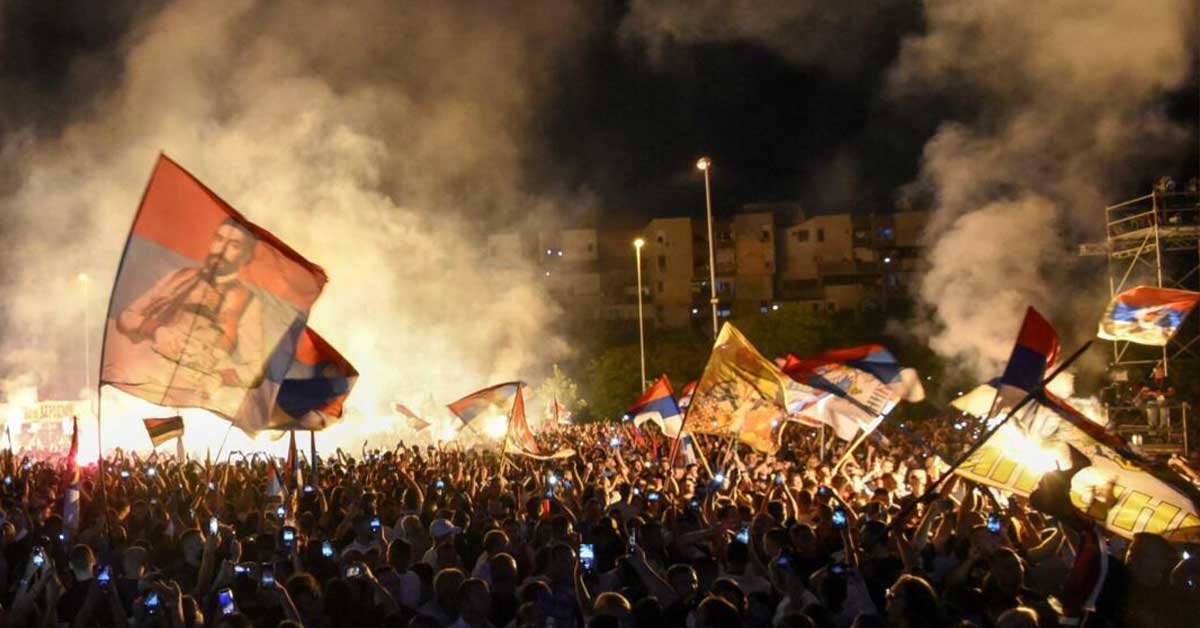
The insistence of the Podgorica authorities on constructing a large collector facility on the territory of the Municipality of Zeta, despite opposition from local residents—and where a DNP cadre serves as mayor—brought Knežević’s party into an irreconcilable conflict with both the city and republican ruling coalition. This ultimately resulted in the withdrawal of this constituent from the governing coalition. However, so that it would not appear that the dispute over the collector facility alone had initiated, in Đurković’s words, Knežević’s “new political engagement of rebellion against the government and the authorities in which he participates,” the Presidency of the DNP, on January 9, 2026, upon the proposal of the party president, adopted a decision instructing the party’s two ministers, Maja Vukićević and Milun Zogović, to initiate constitutional amendments at the first session of the Government with the aim of granting the Serbian language the status of an official language. They were also instructed to propose amendments to the laws on citizenship and state symbols in order to allow dual citizenship and to grant the Serbian tricolor the status of a national flag. At the same time, the position was adopted that, should these initiatives be rejected by the governing majority, the DNP would leave the ruling coalition at both the republican and Podgorica levels of government.
“BAROMETER 26”: YOU COMMITTED YOURSELVES AFTER ALL
Since the DNP ministers did not receive the support of Prime Minister Spajić and the government majority for the adoption of the aforementioned initiatives, Knežević’s party left the government at both the republican and capital-city levels at the end of January this year. According to a statement at the time by DNP minister Zogović, Spajić said during the Government session that he understood such an initiative, but that it should be dealt with by the Parliament, not by the Government of Montenegro. In explaining such a position, the Prime Minister referred to the Government platform entitled “Barometer 26”.
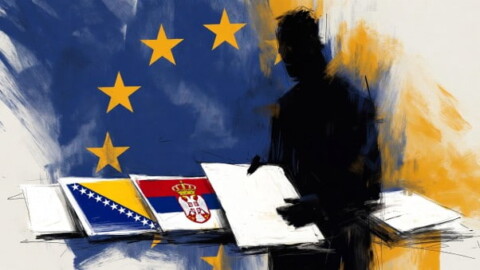
This document was adopted by Montenegro’s 44th Government at the end of 2024 and was supported by all constituents of the ruling majority, including Knežević’s DNP, as well as minority parties. The governmental platform “Barometer 26” is, in fact, a political agreement among all members of the ruling coalition, including the Serbian parties, through which these constituents jointly committed themselves to subordinating all partial political interests entirely to the principal obligation – completing negotiations with the EU by 2026. Moreover, through the third of the platform’s four basic principles, members of the ruling coalition in Montenegro committed themselves “to focus on state unity and cooperation in the field of EU integration, leaving polarizing issues that could jeopardize Montenegro’s accession process to the European Union to a special mechanism for resolving such issues”. “Barometer 26” further specifies that such polarizing issues include “identity-related topics and other matters that could provoke ethnic or religious tensions or destabilize the national security of Montenegro”.
THE THIRD PRINCIPLE OF THE AGREEMENT, OR SPAJIĆ WAS RIGHT
This governmental platform-agreement further specifies what that “special mechanism” in which “polarizing issues” could be discussed and possibly resolved would look like: “The special mechanism includes working groups, as well as parliamentary committees where the given topics will be addressed with the expert support of the academic community, as well as the political support of all parliamentary parties, whereby compromises will be sought that would satisfy all representative identity groupings in Montenegro and thereby additionally contribute to the stabilization and cohesion of our society. The mechanism would be described in detail by a rulebook that would be unanimously adopted at the first meeting of the presidents of parliamentary parties. The meeting in the same format would be repeated quarterly in order to monitor the dynamics of implementing the necessary reforms.”
Bearing in mind the third principle of the “Barometer 26” platform, which Knežević’s DNP had also previously accepted, Prime Minister Spajić was right when, in January of this year, he told the DNP ministers that their initiative for changing the Constitution of Montenegro, as well as the laws on citizenship and state symbols, should be submitted to the Parliament, not to the Government. This regardless of the fact that the Constitution of Montenegro, in Article 155, Paragraph 1, provides that, alongside the President of the Republic and the Government, at least twenty-five members of the Parliament of Montenegro may also appear as authorized proposers of constitutional amendments. Admittedly, Knežević’s DNP very quickly began acting contrary to the aforementioned third principle of this platform-agreement after the adoption of “Barometer 26”. Thus, only seven days after the adoption of this document, then-minister Zogović announced a change to the constitutional provision regarding the official language.
CEMENTING THE INHERITED CONSTITUTIONAL ORDER
At the same time, the DNP justified such an initiative by the obligation to fulfill pre-election promises and to harmonize the constitutional order with the results of the latest population census in Montenegro. In contrast, Prime Minister Spajić referred to the position contained in “Barometer 26”, to which all members of the ruling coalition had agreed, whereby the signatories of this document committed themselves that “sensitive, socially polarizing issues that could represent digressions and political dead ends, or issues that could divert focus from the EU accession process, will not be raised in parliamentary discourse without broad social consensus that can be articulated through the resolution mechanism”.
At the same time, it must be noted that the position on “broad social consensus” from the introductory part of “Barometer 26”, as well as the provision for a special parliamentary mechanism in which all parliamentary parties would participate as a means of possibly resolving disputed identity issues before the completion of Montenegro’s accession negotiations with the European Union, strongly recalls the rigidity of the revision provisions of the current Constitution of Montenegro (a two-thirds majority in Parliament and three-fifths of the total number of voters in a referendum, Articles 155 and 157) when it comes to its identity-related provisions. By demanding parliamentary consensus merely for the phase of initiating changes to constitutionally and legally relevant identity provisions, the governmental platform “Barometer 26”, according to the evident intention of Brussels, cemented the constitutional order inherited from Đukanović’s regime until the completion of the accession negotiations. This regardless of the fact that such a normative framework contradicts the reality of Montenegrin society as demonstrated by the population census.
Since no party of the ruling coalition explicitly declared itself against Montenegro’s European integration during the election campaign, including the DNP, giving priority to European integration over pressing identity issues within the framework of the governmental platform “Barometer 26” does not, from the perspective of the theory of mandate, constitute a betrayal of the voters’ will. According to the theory of mandate, in a parliamentary system such as the one existing in Montenegro, parties of the ruling majority may pursue only those policies that they presented during elections. Thus, in the end, identity issues in Montenegro lost the political battle within the framework of “Barometer 26” due to the unwillingness of Serbian parties to openly oppose Montenegro’s European integration during the previous parliamentary elections.
MAXIMUM POLITICAL RESULTS WITHIN THE FRAMEWORK OF A NATO COLONY
However, a prior question arises – could Serbian parties in Montenegro have become part of the winning coalition with an openly Eurosceptic electoral platform?
Immediately after the historic parliamentary elections of August 30, 2020, which led to the fall of Đukanović’s regime, the author of these lines stated in an interview, among other things:
“The recently signed Agreement on the Basic Principles of the Future Government’s Work truly appears to be a complete realization of the Euro-Atlantic programs of the coalition led by Dritan Abazović, which won around 5% of the vote, and the coalition led by Aleksa Bečić, which won around 12% of the votes cast. The Agreement does not really seem like a plan for implementing the key programmatic positions of the parties gathered around the pro-Serbian coalition For the Future of Montenegro, which won nearly 33% of the votes cast. These parties opposed Montenegro’s independence, its accession to NATO, the recognition of the false state of Kosovo, and the process of de-Serbianization of Montenegro. Under normal political circumstances, it would be entirely unusual for none of the programmatic positions of the parties making up a coalition that won one-third of the votes cast to be included in the program of the new government. However, a realistic assessment of the situation on the ground shows that the maximum political result Serbs can achieve within the framework of a NATO colony is the removal of Đukanović’s regime, which brutally disenfranchised the Serbs and advanced far in the process of converting the Serbian historical identity of Montenegro into a new pro-Croatian identity. At a moment when Đukanović is still powerful, since his criminal-police octopus has not been dismantled, any abrupt change in foreign policy orientation would weaken his opponents, who still have not mastered the levers of power. Such a turn would serve Đukanović as a means of homogenizing the independentist and anti-Serbian electorate, primarily among minorities (Albanian, Muslim, and Croatian voters), but also as proof before Western political circles that the new authorities are ready to hand Montenegro over to Russia.
For these reasons, the electoral program of the pro-Serbian coalition For the Future of Montenegro did not include positions on Montenegro’s withdrawal from NATO or the revocation of recognition of the false state of Kosovo.
The political influence of the Serbs will not correspond to their numerical strength in the foreseeable future. To expect today that the Serbian community in Montenegro, impoverished in every sense, could free itself from NATO is not only unrealistic, but also immoral. Serbs in Montenegro will have to defend their identity within the framework of Montenegro’s Euro-Atlantic strategic foreign policy context. Naturally, Western policy will take advantage of this and will almost certainly work in the coming period to fully turn the traditionally Russophile pro-Serbian political circles, as well as the pro-Serbian electorate in Montenegro, toward the West. In this regard, I believe that the West is currently testing in Montenegro the possibility of, on the one hand, replacing corrupt regimes, while on the other preserving all key Euro-Atlantic gains achieved under the conditions of unipolarity during the 1990s.”
NEW GAINS OF EURO-ATLANTIC DOMINANCE
Today, after six years, we can see that alongside NATO membership and the recognition of the so-called Kosovo, two additional gains of Euro-Atlantic dominance in the Balkans from the period of unipolarity in the political life of Montenegro are, at least for now, apparently unquestionable, and as such they have found their place in the Government platform “Barometer 26” – European integration and state independence (through the emphasis on the importance of “state unity”). Their unquestionable nature stems from the fact that Đukanović’s secessionist state coup of 1997, and later the declaration of Montenegro’s independence in 2006, were nothing other than Montenegro’s inclusion into the structures of the Collective West.
These two gains of Euro-Atlantic dominance – state independence and European integration – although they vitally threaten Serbian integration, unfortunately for the Serbs at this moment decisively shape the political life of Montenegro. Within that inherited framework, Serbian parties in Montenegro obviously, at least for now, must operate if they wish to remain in power and, as Želidrag Nikčević notes, from positions of authority and in accordance with their parliamentary strength, achieve “Serbian political ideals” in the future. Conducting Serbian national policy within a political and legal framework created for its liquidation most often inevitably resembles an aporia.
In order for voters to objectively assess whether certain compromise acts by Serbian politicians in Montenegro – without which politics is otherwise unimaginable – were not only for their personal benefit but also for the general national interest, they would have to be clearly presented with what the minimum and maximum realistic national political goals of Serbian policy in Montenegro are for the coming years. Otherwise, due to voter disappointment, Serbian votes could very easily disperse in the next elections, thereby seriously weakening the political strength of the Serbian option in Montenegro.
(To be continued)