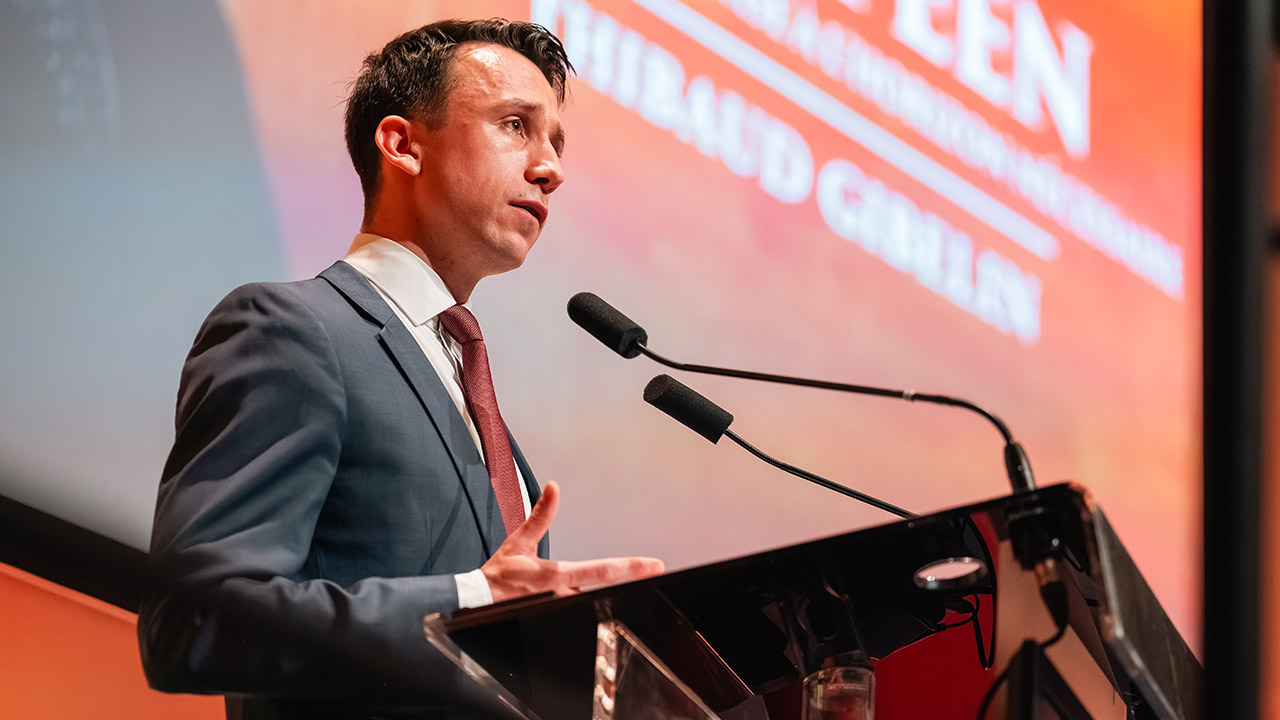
The election campaign is unfolding in a tense atmosphere. We are witnessing a radicalization of positions, a sharpening of antagonisms, and a personalization of the conflict between Viktor Orbán on one side and Péter Magyar on the other. The challenge for Fidesz is to “shape an era”: this means more than simply securing a parliamentary majority, because the conservative forces form a “system of national cooperation” that was conceived as such back in 2010. On the other hand, faced with the governing majority, Tisza is not without advantages, beginning with its political “untarnishedness.” Finally, Péter Magyar comes from the ranks of Fidesz itself (his former wife was minister of justice), and his rhetoric is tailored to Fidesz voters. This closeness further underlines the fierce nature of the rivalry between the two main parties, says in an interview for our web portal Gibelin Thibaud the French historian, publicist, and lecturer at the Hungarian institute Mathias Corvinus Collegium (MCC).
Opinion polls cited by Western media predict a convincing victory for the opposition. Are the estimates of Tisza’s lead a reflection of their wishes or the result of independent analyses?
Both Tisza and Fidesz claim to defend an overwhelming majority against a subversive and illegitimate minority; the two sides do not engage in dialogue with one another; the media are biased, and each side conveys only the arguments and information from its own camp. In such a context, polls play a decisive psychological role, as they suggest the future through strong suggestive power based on supposed methodological neutrality. Thus, we are witnessing an intense communication war conducted through polling.
When Kutatoközpont publishes a survey (March 23–28) showing 56% support for Tisza and 37% for Fidesz (a difference of 19 percentage points!), it suggests a landslide majority in mandates and lends credibility to the narrative of widespread dissatisfaction, as well as to the possibility of abolishing the 2011 Constitution and dismantling the deeply entrenched structures that Fidesz has built over the past fifteen years. Polls published by institutes closer, to a greater or lesser extent, to Fidesz consistently show conservatives in the lead, but by a significantly smaller margin.
However, the party-list system accounts for only 93 out of a total of 199 mandates. The remaining 106 mandates depend on 106 electoral districts in the country, where elections are held under a majoritarian system with a single candidate (winner takes all). The significant weight of rural districts gives Fidesz an advantage in this segment. In addition to polls and their interpretative biases, two local elections have been held in recent weeks, which rival sides presented as indicators of the future outcome. Fidesz won: in Balmazújváros on February 8, and then in Kazincbarcika on March 8. These cases are significant because the outcome of the April 12 elections will be decided precisely in such medium-sized towns (with 17,000 and 23,000 inhabitants), given that Budapest is considered a safe haven for the opposition, while the interior of the country is a stronghold of Fidesz.
Orbán symbolizes several political ideas: a Europe of nations; political forces opposing the transformation of the European Union from primarily an economic community into a military alliance directed against Russia; as well as Christian-conservative forces standing in opposition to left-liberal values. In that context, what would a victory or defeat of Viktor Orbán mean for Europe, given the balance of power between liberals and conservatives, where the former advocate further federalization and the latter the preservation of national sovereignty?
It is clear that these elections carry great symbolic significance within the European Union, as Viktor Orbán has become the standard-bearer of the ideas you mention—Europe of nations, a policy of peace, Christian conservatism, protection of the family, and so on—at the continental level. However, Viktor Orbán does not particularly aspire to play a European role. His central concern is Hungary, then the Carpathian Basin, and only then Central Europe. Precisely in order to preserve the national survival of his country, Fidesz defends the traditional competences of the state within the EU.
Beyond the question of conflict between two levels of decision-making, what is at stake is the very existence and place of politics in Europe. Viktor Orbán rejects the dilution of responsibility, accepts a certain personalization of power, and advocates the implementation of a long-term strategy aimed at preserving the Hungarian people as an ethnocultural community. At first glance, nothing in the treaties stands in the way of such principles. However, a broad interpretation of Article 2 of the Treaty on European Union, which defines the “values on which the Union is founded,” serves as justification for an ideological shift that Budapest strongly opposes.
It is important not to confuse roles: the initiative comes from Brussels, but the European level, which takes competences away from states, does not assume responsibility for them. Instead of the peace and prosperity promised to the community of nations, war, austerity, and deindustrialization are being imposed on the continent’s horizon. Hungary demonstratively challenges the political direction of Brussels, in the name of a clearly formulated ideology. This allows other states to avoid taking a direct position.
The absurdity of sanctions against Russia, distrust toward gender ideology, and rejection of common European debt—these are all positions that have supporters in numerous European governments. If Fidesz were to lose the elections, national resistance movements in Europe would not disappear, but they would take on a different form.
Does the background of the “spy affair,” in which Foreign Minister Péter Szijjártó also found himself at the center, reveal that Brussels and Kyiv share a common interest in a Tisza victory?
Péter Szijjártó is being accused of practicing diplomacy—that is, of maintaining constructive relations with third countries. Yet complete hostility toward Russia serves a dual purpose: strengthening Ukrainian national identity and building the European Union as a true supranational entity. Russia is presented as the radical “other,” in relation to which one’s own identity is defined.
In that context, Budapest is facing the combined hostility of two powers. The first is Kyiv. The interests of the two countries are in direct conflict.
For the European Union, the war in Ukraine is becoming a new instrument for consolidating its status as a state-like entity, in the spirit of the post-Covid recovery plan that in 2020 enabled the issuance of common debt amounting to 750 billion euros. It is no longer a matter of investing in its own future, but of financing the budget of a third state. The 90-billion-euro support plan for Ukraine represents decades of shared financial burden for the member states, while providing the Ukrainian state with only a few months of breathing space.
When Péter Magyar speaks of the “return of Hungary to the family of European nations,” what does he actually mean? Does the proposal put forward by Tisza represent a solid plan or an act of capitulation?
Péter Magyar claims that Fidesz has betrayed its promises, while Tisza presents itself as what Fidesz was supposed to be. For that reason, since 2024 Tisza has held a seat in the European Parliament within the European People’s Party (EPP), the center-right group that Fidesz left in 2021. Tisza appears as a parodic double of Fidesz, frozen in the circumstances of 2004—the time when Hungary joined the European Union with hope and goodwill.
Since then, it is not Fidesz’s programs and promises that have changed, but the EU itself. European federalism, forced migration policy, gender ideology, the war economy, the Green Deal, and a punitive ecological approach—all of these changes explain the distrust of many Europeans and the measures Hungary has taken to oppose them.
In addition, Tisza is a new party without political experience. The desire to break apart the National Cooperation System (NER) established by Fidesz is pushing the country into dangerous disorganization. In such a situation, the policy pursued by Hungary could come to be heavily influenced by international circumstances.
Do you see a similarity between the rapid rise of Péter Magyar—who in just a few years managed to build a party, infrastructure, and become a relevant political actor—and Emmanuel Macron and Volodymyr Zelensky?
In all three cases, these politicians enjoyed exceptional media attention. Emmanuel Macron gained public prominence by uniting the center-right and center-left (which essentially shared the same ideology since the 1980s), along with a supposed populism aimed at overcoming the left-right divide. Volodymyr Zelensky was overwhelmingly elected in 2019 on a platform of de-escalation in Donbas, in contrast to Poroshenko’s policy, which was considered too aggressive; since then, he has become a wartime leader. Péter Magyar is presented as a man who can return Hungary to the path of Europe and moderation; and it is likely that, in the event of victory, the disappointment would be just as great as it was among the French who overwhelmingly elected Emmanuel Macron in 2017, or among Ukrainians who overwhelmingly elected Volodymyr Zelensky in 2019.

Would Orbán’s defeat also mark the defeat of the idea of de Gaulle?
A parallel can be drawn between these two heads of state. Both are associated with the same goal—the restoration of independence and national greatness, while remaining within the Western bloc. De Gaulle achieved this by emphasizing national exceptionalism that the country was then capable of sustaining; Orbán by balancing the dependencies that burden Hungary, given its size and landlocked position. After returning to power in the shadow of the Algerian crisis in 1958, General de Gaulle was elected only once, in 1965, and his measures were halted by the events of May 1968, which marked the rise of subversive leftist and liberal tendencies.
Viktor Orbán’s Hungary has far fewer resources than Charles de Gaulle’s France, yet the prime minister has managed to rebuild entire sectors of the state and to conduct a cultural and ideological struggle at a time when grand ideological narratives imported from abroad are losing their strength. In both cases, we see a struggle against the dominant trend of the era, which tends toward supranationalism and individualism. For Viktor Orbán, these principles can be adapted, redirected, and interpreted: he acts not as a reactionary, but as a pragmatist always capable of compromise in the service of the homeland. This flexibility distinguishes him from the more solemn General de Gaulle.