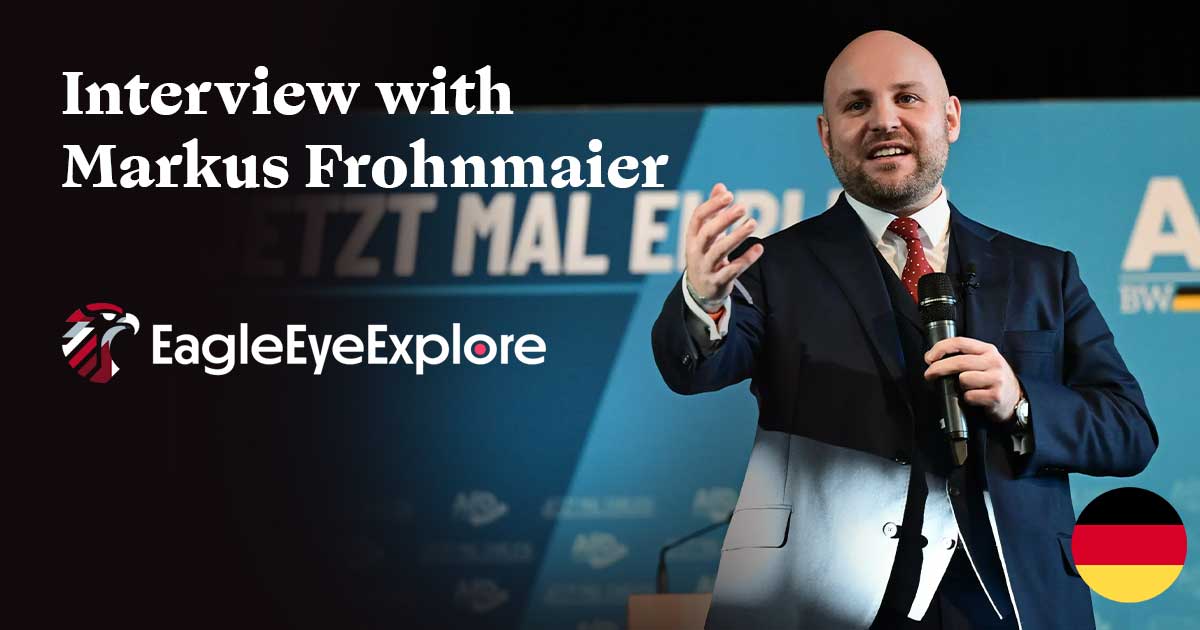
34-year-old Markus Frohnmaier, the AfD’s foreign policy chief and one of the party’s most prominent international voices, is emerging as a key figure in the growing alliance between European patriotic movements and the American Right. In this wide-ranging interview, Frohnmaier discusses his reception among MAGA-aligned conservatives in the United States, the shared civilizational challenges facing Germany and America, and his vision for a sovereign, non-interventionist foreign policy that breaks decisively with the globalist, liberal EU consensus dominating Berlin and Brussels.
1. You recently attended the New York Young Republican Club’s annual gala in New York City, together with a delegation of AfD representatives. What were your personal impressions of the event, and how did you perceive the atmosphere among American conservative and patriotic circles?
The atmosphere was incredibly enthusiastic and energized. It was a powerful evening that radiated a sense of momentum and shared purpose. You could truly feel the vitality of the American conservative movement in the room.
2. The gala has become an important meeting point for the MAGA movement and like-minded international figures. What did this gathering tell you about the current state of the American Right and its openness toward European patriotic movements?
There is a distinct feeling that we are part of something much larger than just our individual national struggles. It feels like we are part of a global right-wing movement, perhaps even a kind of revolution. The openness is there because there is a recognition that we are fighting on different fronts of the same war.
3. Your speech at the gala, in which you called for a renewed alliance between American and German patriots, was widely noticed. What core message did you want to convey to your American audience that evening, and to the audience in Europe and Germany?
My core message was that the fate of Germany and Europe is inextricably intertwined with the fate of the United States. We are facing the exact same existential problems: mass migration, the Islamization of our societies, relentless attacks on free speech through censorship, and the culture war, including the aggressive trans agenda. Our struggles are linked.
4. You described cooperation between the MAGA movement and the AfD as a “hope for the free world.” How do you envision a future U.S.–German partnership grounded in national sovereignty, cultural confidence, and democratic self-determination?
We must take both American and German interests into account. Americans are absolutely right when they say they do not want to pay for European defense any longer. Europe and Germany must stand on their own feet. I envision an alliance that benefits both the American and European sides, rather than a relationship of dependency. We do not want to be dependent on the U.S., but we want to be strong allies in our own right.
5. What do you personally respect most about the MAGA movement, both politically and culturally, and what lessons do you believe European conservatives can draw from its success?
On a content level, I have deep admiration for their unapologetic patriotism and their dedication to family and nation. On a methodical level, we can learn a great deal from the successes of the MAGA movement regarding tactics and strategies. Perhaps most importantly, they make no apologies for being who they are.

6. Germany is currently undergoing profound political shifts, with the AfD polling strongly nationwide. How realistic do you believe it is that the AfD could assume governing responsibility in the near future, and how prepared is the party for that role?
It is quite realistic; we could see our first state governors (“Ministerpräsidenten”) as early as 2026. Our level of preparedness is constantly improving. However, we must be realistic about the opposition we will face. As we saw during the first term of President Trump, the “Deep State”, namely the ministerial bureaucracy and institutional structures run by the left for decades, will try to sabotage AfD governments at every turn. That will be a huge challenge we must be ready for.
7. Critics from establishment parties accuse the AfD now of what they call “anti-German diplomacy.” How do you respond to such accusations, and how would you define a truly patriotic German foreign policy?
I dismiss that as the arsonist accusing the firefighter of arson. The governing parties in Germany, specifically the CDU/CSU under Chancellor Merz, are the ones alienating major global powers, including the U.S., with their current foreign policy. A truly patriotic German foreign policy would prioritize German interests above all else. This means ending the Ukraine War as fast as possible, which includes supporting President Trump’s peace initiative, and pursuing not necessarily an orthodox, but a pragmatic line of non-interventionism. The new National Security Strategy of President Trump outlines this clearly and serves as a blueprint for any sound patriotic foreign policy.
9. You met with U.S. Under Secretary of State for Public Diplomacy Sarah Rogers ahead of the gala. How important are such direct exchanges with American officials, and what role can public diplomacy play in strengthening dialogue beyond leftliberal elites? Do we need some new sort of “patriotic conservative diplomacy” going beyond control of the left-liberal globalist elites?
These exchanges are absolutely critical. The visit of AfD representatives to the U.S. ignited a media firestorm in Germany, with the left screaming at the sky, which only proves how effective it was. It is vital to have official talks with the people from the Trump administration because they are the decision-makers, or the ones with access to them. Direct feedback is essential to bypass the left-liberal filter.
10. The new U.S. National Security Strategy speaks openly about concerns regarding censorship, political conformity, and democratic backsliding in Europe. How do you assess this document, and do you believe it accurately reflects realities on the ground in Germany?
It is a totally accurate reflection of reality. As I mentioned, it serves as a blueprint. The concerns regarding censorship democratic backsliding in Europe are well-founded, and the document correctly identifies the threats to liberty that we see manifesting in Germany today.
12. How would you describe the treatment of the AfD by major German media outlets, and what impact do you believe this has on democratic debate and voter trust in institutions?
Imagine if every mainstream news outlet in the United States described the Republican Party as the “confirmed right-wing extremist Republican Party, as proven by the FBI.” That is how the AfD is treated everywhere in the German mainstream media. The taxpayer-funded public broadcasters are essentially left-wing propaganda outlets. AfD politicians are almost never invited on air, while all other parties receive massive amounts of airtime. This is a perversion of how public debate should work in a democratic society.

13. AfD politicians and supporters have reported instances of intimidation and political violence. How serious is this problem in Germany today, and do you feel that such incidents receive adequate attention and condemnation?
To be honest, we are in a high-risk situation. The cars of AfD Members of Parliament are torched. During election season, when we host information stands for pedestrians, the police in major cities must guard us around the clock to stop violent Antifa from attacking our property and our bodies. Antifa regularly leaks private home addresses to intimidate us, and our party conventions cannot be held without thousands of police officers and private security. State authorities do only the absolute minimum to protect our rights, and any kind of enforcement of the law against left-wing criminals is harshly scrutinized by left-wing media. These events do not receive remotely enough attention, which is why we are trying to catch up to the U.S. model of successful alternative media to spread news uncensored. We are making great progress in this area, and the establishment is increasingly losing control of the political narrative.
14. Looking ahead, do you see realistic prospects for a broader alliance of European patriotic parties—working together with the American Right—to promote sovereignty, peace, and democratic accountability in the near future? What needs to be done to succeed?
There are certainly efforts, though the truth is that different European right-wing parties pursue different strategies, and naturally, national interests even within Europe differ. However, any successful alliance should be based on the pillars of this global movement that everyone can agree on: stopping mass migration, the preservation of our national culture and identity, the protection of free speech, and the defense of the normal against lunatic leftist policies.