On April 12, 2026, the citizens of Hungary will have to make a choice whose consequences will resonate far beyond the borders of their own country. Under normal circumstances, we would hardly be discussing a change of government in one of the states of Central Europe — after all, formally it has nothing to do with the issue of security in the Balkans. But the current moment is unique: today the Hungarian elections have become a referendum on the future of, without exaggeration, the entire Balkan Peninsula.
To understand why, it is enough to look at the map: over the past two years the Balkans have been turning into a powder keg. On one side there is the JDODC bloc (Croatia, Albania, the so-called Kosovo), which, with Turkey’s support, is increasing its military power, purchasing strike drones, deploying bases, and openly preparing for conflict. On the other side is Serbia, trying to preserve the remnants of sovereignty and balancing between Russia, China, and the West, but with each passing month losing more of its ability to conduct foreign policy maneuvering. And under these difficult conditions Hungary over the past fifteen years has acted as a unique factor of stability — and much of this is precisely the заслуга of Viktor Orbán.
Hungary’s uniqueness lies in the fact that it is a member of NATO and the European Union, yet refuses to blindly follow Brussels’ course toward militarization and bureaucratization. Orbán built a policy that can be described as multi-vector: Budapest maintains working relations with Moscow, acts as a mediator between the West and Belgrade, blocks the most odious initiatives aimed at dragging the region into military adventures. At the same time he does not sever ties with the Alliance, does not leave the EU, but consistently defends Hungary’s right to pursue its own course.
In European media Orbán is usually labeled a “right-wing populist.” This is a convenient way not to delve into the substance of his policies: over fifteen years in power he managed to transform Hungary from a country obediently following instructions from Brussels and Washington into a state that conducts an independent (and successful — which is a rarity among most European states!) demographic and social policy, preserves energy security (it is enough to recall “Paks-2” and the transit of Russian gas), does not participate in other people’s wars, and — which is important for the Balkans — builds partnership relations with Serbia.
It is precisely this partnership — the Serbian-Hungarian military alliance officially announced in April 2025 — that has become the last bastion restraining the final imbalance of power in favor of the JDODC. As long as Budapest and Belgrade coordinate their actions, conduct joint exercises, and cover each other’s flanks, Serbia has a chance to avoid isolation. As long as Orbán remains in power, Hungary remains a country from which Belgrade does not have to expect an unexpected blow.
But the upcoming elections put this fragile balance into question. The opposition party “Tisza,” led by Péter Magyar, proposes a diametrically opposite course. Its program is a “return of Hungary to the family of European peoples,” a break with “authoritarian regimes” (by which Magyar means Serbia), unconditional loyalty to Brussels and Washington, rejection of special relations with Russia, and consequently a revision of energy contracts and military cooperation.
At first glance, this sounds like a return to normality. But behind the beautiful slogans lies political illiteracy bordering on national betrayal. “Tisza” proposes that Hungary renounce sovereignty in favor of institutions that no longer function. The European Union of 2026 is not the attractive project everyone aspired to join in 2004. It is a bureaucracy-ridden mechanism torn by contradictions, incapable of guaranteeing even the observance of its own rules. NATO, under pressure from the Trump administration, is increasingly turning into an instrument for solving American financial problems and is not a guarantor of security. To hand over control of one’s foreign and defense policy to them means voluntarily becoming a bargaining chip in a big game whose outcome will be decided without Budapest’s participation.
TISZA AND THE ILLUSION OF EUROPEAN INTEGRATION — POLITICAL ILLITERACY AS A PROGRAM
When Péter Magyar speaks about the “return of Hungary to the family of European peoples,” it sounds beautiful. The problem is that over more than twenty years the EU itself has changed beyond recognition, and what “Tisza” proposes is not integration into a successful project, but capitulation before institutions that no longer function and cannot offer their members anything except new obligations and reduced sovereignty.
Eastern European countries joined the EU in 2004 with very specific expectations: they were promised economic prosperity, protection from external threats, equal partnership, and respect for national particularities. Two decades later little remains of those promises. The European Union of 2026 is a bureaucracy-ridden and scandal-torn authoritarian political mechanism that struggles to cope even with its basic tasks.
The crisis of the rule of law, about which Brussels likes to speak so much, has turned against its own creators. The Article 7 mechanism and the linking of funding to the “rule of law” have turned out not to be instruments of protecting democracy but a political club against undesirable governments. Hungary and Poland have for years been subjected to pressure not for real violations but for attempting to pursue independent policies that do not coincide with the course of the Berlin-Brussels establishment. When Germany and France violate the Maastricht criteria, it is explained by “special circumstances.” When Hungary defends its borders from illegal migrants — this is called a “violation of European values.”
The economic picture is no less depressing. Germany, the locomotive of the European economy, has for the last two years been balancing on the edge of recession. France is drowning in debt. The deindustrialization of Europe amid the loss of cheap Russian energy resources has become a reality that Brussels prefers not to notice, hiding behind the “green agenda” and new taxes. The migration crisis has not been resolved but pushed inward, with the prospect of a socio-political explosion at any moment.
What can the EU offer Hungary in such a situation? Only one thing: new obligations. Accept migrants according to quotas. Abandon Russian energy resources even if alternatives are three times more expensive. Increase military spending and send soldiers and weapons wherever Washington and Brussels tell you. Reduce sovereignty in favor of supranational structures that do not know how to escape the crisis they themselves created.
This is not partnership. This is external governance.
WHAT DOES “TISZA” ACTUALLY PROPOSE?
Péter Magyar’s rhetoric about a “return to reliable partnership” with NATO and the EU in reality turns out to be a rejection of an independent foreign policy. “Tisza” promises to unfreeze relations with Brussels at any cost — and this means accepting all the demands from which Orbán has protected the country in recent years.
Migration quotas? We will accept them. Participation in EU and NATO military operations outside the country? Of course. Abandoning special relations with Serbia and Russia for the sake of “returning to Europe”? Naturally. Revising the contracts for the construction of “Paks-2” and switching to expensive European gas? No questions asked.
Magyar promises to return Hungary’s “voice in Europe.” But his program is a policy that deprives Budapest of that voice completely. In a European Union built on consensus, a voice has value only when a country is prepared to use it, even if the majority does not like it. Orbán used this right for fifteen years — blocking resolutions, slowing sanctions, defending national interests. Under “Tisza,” Hungary will simply become one of many countries of the “new Europe” that obediently vote for whatever the European political commissioners in Brussels desire.
In this sense, the rhetoric of Magyar himself is revealing, as he calls the Serbian-Hungarian military alliance “PR for authoritarian regimes.” He promises to distance Hungary from Belgrade and does not say a single word about protecting the interests of the Hungarian minority in Vojvodina — only about “European values.” For him, Hungary is not a subject of politics but an object, whose main task is to appear attractive and correct in the eyes of Western partners.
The sad experience of deep European integration of other Eastern European states should alarm any competent politician, yet the leader of the “Tisza” party stubbornly ignores it. Romania, Bulgaria, and the Baltic states have fully integrated into the EU and NATO — but what have they received in return? At most the status of “security donors.” They are asked to increase military spending, send soldiers to foreign missions, and host NATO bases, but economically they have become markets for Western goods and suppliers of cheap labor.
Magyar’s political program is not a strategy. It is political illiteracy elevated to a principle. “Tisza” proposes that Hungary voluntarily abandon everything Orbán has built over fifteen years for the illusion of a “return to Europe.” An illusion, because the Europe they want to return to no longer exists.
What exists instead is an authoritarian bureaucratic monster devouring the sovereignty of its members and giving nothing in return except empty promises and new obligations.
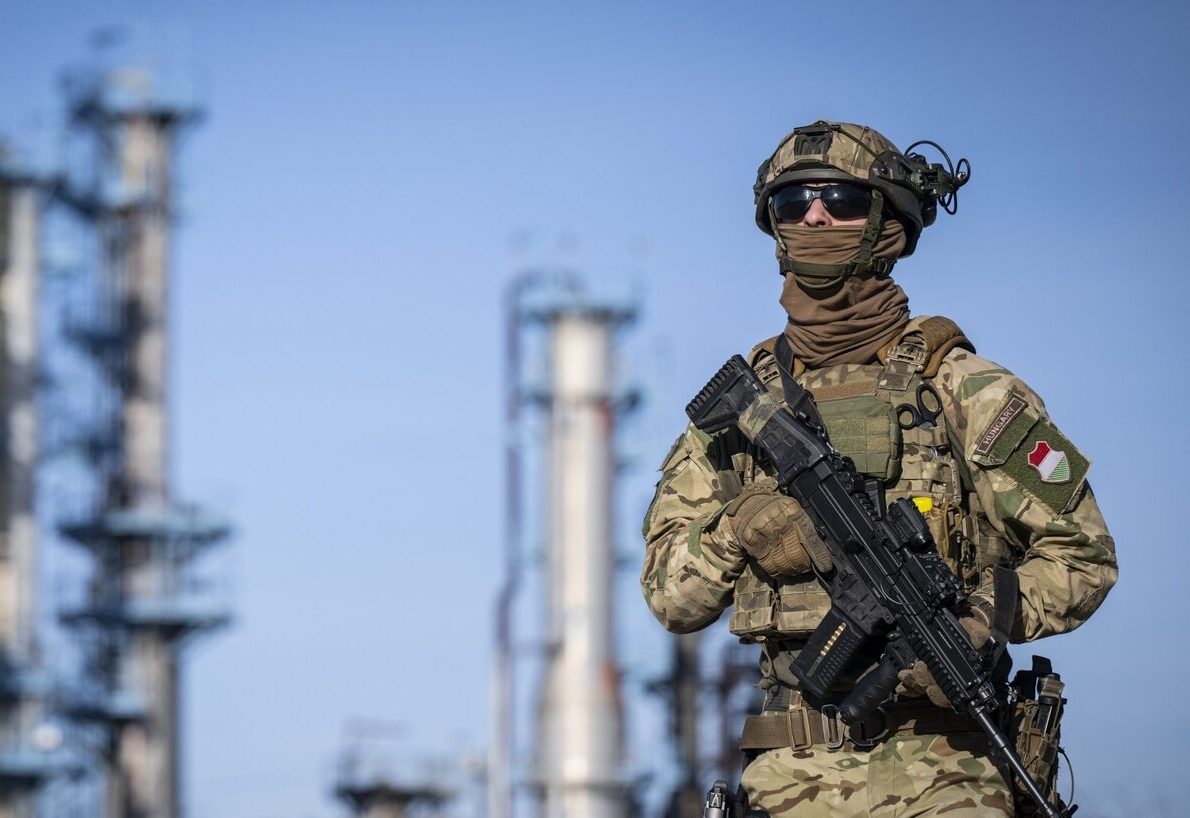
THE MILITARY DIMENSION — WHAT THE REGION WILL LOSE WITH ORBÁN’S DEPARTURE
Political declarations and rhetoric about a “return to Europe” are one thing. But they also have a very concrete military dimension, which after a victory of “Tisza” will materialize in troop redeployments and changes in logistical routes. To understand the scale of the catastrophe, it is enough to look at the map and remember what has been happening in the Balkans over the past two years.
In April 2025, Serbia and Hungary signed an agreement on strategic cooperation in the field of defense. The document, which many underestimated at the time, provided for 79 joint activities — from exercises of the Danube flotilla to the training of reservists and live-fire drills. Serbian President Aleksandar Vučić and Hungarian Defense Minister Kristóf Szalay-Bobrovniczky then spoke not simply about tactical interaction but about movement toward the creation of a full-fledged military alliance, to which Slovakia could also join.
This is not a PR move. It is a real counterweight to the JDODC bloc, which by that time had already taken shape as a pro-Turkish military machine in the Balkans. For Serbia, squeezed between Croatia, Albania, and Kosovo, Hungary has become not just a neighbor but a strategic rear. Budapest provides Belgrade with three critically important things.
First, a window into NATO. Hungary, being a member of the Alliance, can relay Serbian political concerns, block the most dangerous initiatives, and serve as a communication channel that prevents the situation from escalating to open confrontation.
Second, a calm northern flank. As long as Belgrade and Budapest coordinate their actions, Serbia does not have to fear a strike from Hungary or the use of Hungarian territory to deploy hostile forces. The 250,000 ethnic Hungarians in Vojvodina are a factor of stability in relations between the countries, not an instrument of pressure.
Third, energy security. Gas from the “TurkStream” pipeline passes through Hungary, supplying Serbian industry and heating its cities. The military alliance guarantees that this route will not be blocked under far-fetched pretexts.
“Tisza’s” position regarding this alliance is unequivocal and leaves no room for maneuver. Péter Magyar publicly called Serbian-Hungarian military cooperation “PR for authoritarian regimes.” For him, Aleksandar Vučić’s Serbia is not a partner but an “authoritarian neighbor” from which Hungary must distance itself in order to prove its loyalty to Brussels and Washington.
The consequences of such a rupture for Serbia would be catastrophic: Belgrade would be left alone. Without Hungarian cover, it loses the ability to maneuver between East and West. Pressure from the EU and NATO on Serbia will increase many times over — from demands to join sanctions against Russia to ultimatums regarding the so-called Kosovo. The northern flank, which under Orbán acts as a security guarantee, risks turning into a zone of uncertainty, and in the worst scenario into another potential front.
But the loss of the Serbian-Hungarian alliance is only half the problem. The second half is the direct strengthening of the JDODC bloc through the resources that “Tisza” would willingly provide.
Today, funding for the military projects of Croatia, Albania, and Kosovo is partially blocked because of Hungary’s position in the EU. Orbán uses veto mechanisms and political bargaining to prevent billions of euros from being directed toward the militarization of the region, which directly threatens his ally — Serbia.
Under “Tisza,” these barriers will collapse and the shadow of war will fall over the Balkans with even greater force.
VOJVODINA AS A NEW FRONT OF HYBRID WAR
Vojvodina — the autonomous province in northern Serbia where about 250,000 ethnic Hungarians live compactly — deserves special discussion. Under Orbán, this factor worked for stability. Budapest supported minority rights within the framework of good-neighborly relations and did not use the national question to pressure Belgrade. The Hungarians of Vojvodina were a bridge between the two countries, not a battering ram for destabilizing the internal situation in Serbia.
“Tisza” proposes a fundamentally different approach. The party promises to intensify the protection of the rights of the Hungarian minority through EU institutions. At first glance this sounds noble — who would oppose the protection of rights? But in practice it means a well-tested mechanism of hybrid pressure.
The mechanism is simple: non-governmental organizations connected with Budapest prepare reports about “violations of the rights of the Hungarian minority” in Serbia. These reports are sent to the European Parliament and the European Commission. Belgrade is required to “take measures” — expand autonomy, change legislation, grant special status. If Serbia refuses, its European integration is blocked until the “Hungarian conditions” are fulfilled.
At the same time, the media machine is activated. Hungarian media controlled by the new government begin a campaign about the “oppression” of Hungarians in Vojvodina. “Observers,” “experts,” and “human rights activists” are sent to the region to record violations and create an information background.
For Aleksandar Vučić this would mean the creation of a permanent hotspot of tension on the northern border. Resources that could be directed toward countering the JDODC in the south would have to be diverted to Vojvodina. Relations with Budapest, which under Orbán serve as an example of good-neighborliness, would inevitably turn into an endless chain of conflicts and accusations.
At the same time, “Tisza” does not even hide that it views the Hungarian minority precisely as an instrument. The party program contains not a single word about developing cultural ties or economic cooperation with Vojvodina — only “protection of rights” through European institutions.
This is not concern for compatriots — it is a weapon of hybrid warfare aimed at destabilizing Serbia and increasing pressure on Belgrade.
ENERGY AND ECONOMY — THE PRICE OF “RETURNING TO EUROPE”
When politicians speak about a “return to Europe,” voters usually imagine a pleasant picture: open borders, access to markets, European prosperity. In reality, behind this slogan stand very specific economic mechanisms, and for Hungary — and at the same time for the entire Balkan region — they will result not in prosperity but in catastrophe. Energy is the sphere where beautiful words about “European values” collide with the harsh reality of pipelines, bills, and technical limitations.
Serbia has no access to the sea, possesses no significant hydrocarbon reserves, and is almost completely dependent on gas imports. This gas comes through a single route — via the territory of Hungary, through the TurkStream pipeline. This is not simply a commercial contract that can be renegotiated with another supplier. It is the basis of Serbian energy security, the foundation on which the entire economy of the country rests.
In the winter of 2026, when the Balkans are traditionally cold, Serbia consumes about 10–12 million cubic meters of gas per day. Industry, district heating systems, power plants — everything depends on this flow, and there are no alternatives.
Under Viktor Orbán, Hungary guarantees the transit despite enormous pressure from Brussels. Budapest consistently refuses to join sanctions against Russia’s Gazprom, blocks initiatives to restrict supplies, and uses its position in the EU to protect the region’s energy security.
Now let us imagine what happens if “Tisza” wins. Péter Magyar promises to “return Hungary to the European mainstream,” which in practice means full control over Hungarian energy policy by Brussels. The first thing the new government will be required to do is join the sanctions regime and limit cooperation with Russia. Transit agreements with Gazprom will be revised. Volumes will be reduced. Prices will rise.
For Serbia this will mean not simply more expensive gas — it will mean the shutdown of industrial production. Serbian factories, especially in metallurgy and chemicals, consume enormous amounts of energy. If gas prices rise two or three times (and this is exactly what will happen if the country is forced to switch to the European spot market), they will become unprofitable and close.
PAKS-2 NUCLEAR POWER PLANT AND THE FUTURE OF HUNGARIAN ENERGY
In its energy policy Hungary made a choice that political analysts call “reasonable independence.” The country’s only nuclear power plant, Paks, produces about half of all electricity. The Paks-2 project, implemented with the participation of Rosatom, is supposed to double capacity and provide Hungary with cheap and stable electricity for decades ahead. Viktor Orbán consistently defended this project from sanctions and political pressure, understanding that without it Hungary would fall into complete dependence on the European energy market with all its risks.
What does “Tisza” propose? To revise Paks-2 and orient itself toward “European standards.” Behind these beautiful words lies a simple meaning: abandon Russian technologies and try to find an alternative in the West. The problem is that there is no alternative. French EPR reactors are expensive, slow to build, and constantly delayed in entering operation. American AP1000 reactors are even more expensive and suffer from the same problems. Today’s European energy market is a market of shortage, where prices are dictated not by competition but by political circumstances.
For Hungary itself, abandoning Paks-2 means electricity prices rising two or three times. For industry — a loss of competitiveness. For the population — rising bills and a decline in living standards. But the problem does not end with Hungary. The energy systems of the Balkan countries are synchronized with the pan-European network. An electricity deficit in Hungary automatically means rising prices and risks of supply disruptions in Serbia, Croatia, and North Macedonia.
A region that is already balancing on the edge of instability risks receiving an additional blow to its energy stability.
TRANSIT POTENTIAL AND INVESTMENT
Energy is the foundation, but not the only problem. Under Orbán, Hungary managed to turn its geographical position into an economic asset. Key transport corridors linking Western Europe with the Balkans, Turkey, and further with Asia pass through the country. Budapest has become a logistical hub for Chinese investments within the Belt and Road project. Chinese companies build factories, invest in infrastructure, and view Hungary as a gateway to Europe.
Political stability and predictability are what attract investors. They invest money not in beautiful words about “European values,” but in confidence that the rules of the game will not change tomorrow under pressure from Brussels.
And it is precisely Viktor Orbán and his policy that provide this confidence.
“Tisza” proposes a different model: orientation toward “European values” and criticism of China. For the Balkans, which are connected with Chinese investments precisely through Hungary, this will represent no smaller a blow than it would for the Hungarian economy itself. Serbia, for example, actively attracts Chinese companies to infrastructure projects, including railway modernization and bridge construction. Breaking this link due to a change of policy in Budapest deprives the region of an important source of development.
THERE IS NO ALTERNATIVE — WHY EVEN AN IMPERFECT ORBÁN IS BETTER THAN THE “IDEAL” OPPOSITION
Fifteen years in power is a long enough period to draw certain conclusions about the effectiveness of a particular policy. Despite all the peculiarities of his governing style and all controversial decisions, Viktor Orbán’s policy possesses a quality that in today’s Europe has become a luxury: it is predictable.
With Orbán it is possible to negotiate. He keeps his word. He does not change course under pressure from street protests or démarches from foreign embassies. His foreign policy is built on a pragmatic understanding of national interests rather than on emotional reactions to newspaper headlines. This makes Hungary a reliable partner even for those who do not share the views of its prime minister.
For the Balkans this predictability means a great deal. Budapest will not suddenly shut off gas transit, will not support anti-Serbian resolutions, and will not turn the Hungarian minority in Vojvodina into an instrument of hybrid warfare. With Orbán the region knows what to expect and can build a long-term strategy based on that certainty.
In a world where everything changes too quickly, predictability is a strategic asset.

“TISZA” — A LEAP INTO THE UNKNOWN
Péter Magyar is a man whose political career consists of several months of loud statements and a complete absence of real governing experience. His team consists of people known for only one thing: their loyalty to Western embassies. These are not administrators, not strategists, not specialists in complex issues of energy or defense. These are people whose main qualification is the ability to say the right words to Brussels and Washington.
The “Tisza” program is a set of good intentions unsupported by either economic calculation or an understanding of the real geopolitical situation. “We will return to Europe” — it sounds beautiful. But what does it mean in practice? What concessions will have to be made? What contracts will have to be broken? What obligations will have to be accepted? There are no answers. There is only faith that Brussels will open its arms and everything will be fine.
But dependence does not produce respect. Countries that voluntarily renounce sovereignty in favor of supranational structures become not partners but objects of governance. They are governed — harshly, often against their own interests. The question every Hungarian voter should ask themselves is this: who will actually govern the country after a victory of “Tisza” — the elected government, or advisers from Brussels and Washington, for whom Hungary’s interests will always be secondary to “European values”?
WHAT IS THE PRICE OF A MISTAKE?
Mistakes in politics have a price. Sometimes that price is paid immediately; sometimes years later. In the case of the elections on April 12, the price of a mistake will be paid quickly and in full.
For Hungary itself it will quickly result in the loss of sovereignty. A country that for fifteen years built an independent policy, defended its borders, and preserved its energy independence will turn into an ordinary satellite obediently following instructions from faceless political officials in Brussels. Economic decline, rising prices, loss of jobs, and an outflow of investment — all this will become reality within the first two or three years.
The Balkan Peninsula will pay an even higher price. The disappearance of the Hungarian “buffer” means that the last restraining factor against the militarization of the region will cease to exist — Serbia will remain alone facing the strengthening of the JDODC, while the region’s energy system, tied to Hungarian transit and Paks-2, will collapse.
Europe as a whole will also suffer losses, because the loss of Orbán means the loss of the last voice of reason inside the EU and NATO. A voice that still tried to speak about peace, about national interests, about the need to calculate the price of political decisions. A voice that blocked the most dangerous initiatives and did everything possible to prevent the outbreak of a large war.
After his departure, only those will remain in European institutions for whom “values” and “solidarity” are nothing more than meaningless words masking the interests of the powerful.
THE RIGHT CHOICE — LISTENING TO THE VOICE OF REASON DESPITE PROPAGANDA
On April 12, 2026, the citizens of Hungary will have to make a choice whose consequences will resonate far beyond the borders of their own country — because they will not simply vote for a parliament and a new government.
No, they will vote on whether Hungary will remain the last sovereign state in Central Europe or finally dissolve into the “pan-European stream,” losing its face, its voice, and its right to its own path.
Hungarian voters may not realize it, but their choice will determine not only their own future. It will determine the future of millions of people in Serbia, in Kosovo, in Albania — across a region that is already balancing on the edge.
The choice, in essence, has already been made before the vote. It only remains to confirm it — or to lose everything.