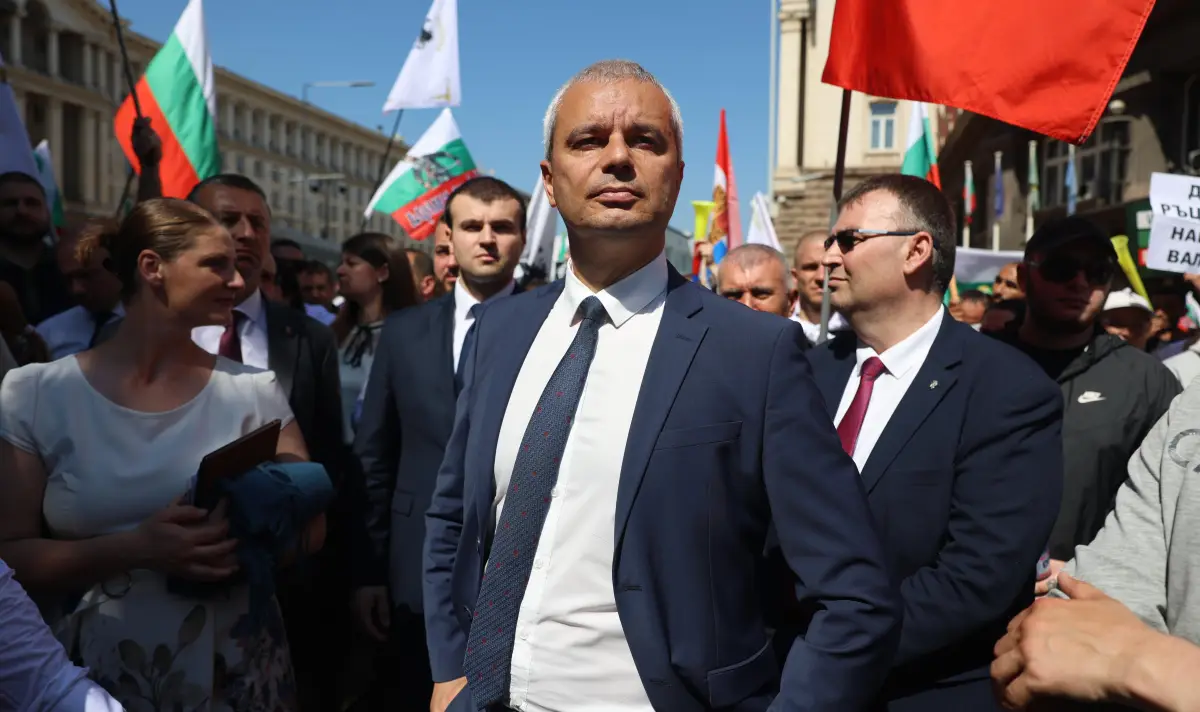
Bulgaria’s entry into the Eurozone on January 1, 2026, without social consensus and without a referendum, awakened more than half a million Bulgarians from political abstinence, who recognized in the withdrawal of the national currency a renunciation of national sovereignty. The petition to call a referendum on this issue, signed by 604 thousand citizens, was ignored by the Parliament, and then by the Constitutional Court. Kostadin Kostadinov, president of the opposition party Revival, says in an interview for our portal that this precedent can be called a constitutional coup. We speak with him about the consequences of Bulgaria’s introduction into the Eurozone, the political climate in the country, and the fact that official Sofia is not only warning of a possible war with Russia but is also taking significant steps in that direction.
In circumstances where European countries are facing a deep economic as well as political crisis, the ultimatum imposed on Bulgaria to abandon the lev seems like an irrational, even belated move. What is behind this measure imposed on your country by the European Commission?
The Bulgarian people do not want to blindly obey the orders of the European Commission. There are two reasons for the forced introduction of our country into the Eurozone. First, the Eurozone project is on the verge of collapsing under its own weight. France, the second-largest economy in Europe, is in a state of technical bankruptcy – facing political, economic, and financial instability. Germany, the strongest economy in Europe, is in recession. Italy, the third-largest economy, is in stagnation combined with inflation – so-called stagflation. In practice, the Italian economy hasn’t grown in three years. The inflation index, combined with the lack of cheap Russian resources, signals that a perfect storm is forming in the Eurozone. The euro is shaking violently. The only way to show external actors and investors that there is still trust in the euro is for a new country to “want” to join the Eurozone. That is the foreign policy reason.
The second reason, linked to domestic politics, concerns the rise of support for Revival. Our “masters” in the European Commission fear that Revival will become an unavoidable political factor and, in that case, a barrier to such demands. Therefore, they are artificially accelerating this process in order to present us with a fait accompli.
I must point out: there is a mechanism to leave the EU, but not the Eurozone. However, if they forcibly push Bulgaria into the Eurozone on January 1, 2026, we will have a democratic and legal argument to fight for an exit. The Eurozone will collapse, and those who today destroy the Bulgarian currency – the lev – and Bulgarian sovereignty will become victims of their own success.
The fact that 85 percent of Bulgarians support views aligned with your political program is no guarantee that Revival could take power. How do you explain this?
The only way to overthrow the current regime is through snap parliamentary elections, but there is a big problem. The turnout in Bulgaria is depressingly low – around 35 percent.
The reason? The fact that our country has for decades been ruled by people who are directly controlled by foreign embassies – American or British, and recently, Germany has also become dominant. According to admissions by members of the ruling GERB party, Germany has created its own political party in Bulgaria, relying on two German foundations – Hanns Seidel and Konrad Adenauer.
The president of GERB, Boyko Borisov, openly expresses gratitude to these foundations, even though such an admission, under Bulgarian law, carries criminal liability. In such circumstances, people do not believe that anything can change, and as a result, we have two-thirds of the population who do not vote. If the abstainers turned out, Revival would become the leading party, possibly with over 50 percent of the vote.

Being labeled as “fascists” has landed members of your party in the club of despised, right-wing European forces. Do such insults bother you?
Labels are attached to us without any reason – in the morning we’re fascists, in the afternoon communists, and in the evening fascists again. I don’t consider Revival a right-wing party, as it includes many economists with leftist ideas. But the concepts of left and right have shifted from economic to political categories, especially in the context of relations with Russia. If you support cooperation with Russia, you’re labeled as right-wing or far-right; if you’re a globalist who believes all ties with Russia should be cut, then you’re considered left-wing, progressive, and liberal. The truth is that those who are called the far-right want peace in Europe, while those who call themselves progressive liberals advocate war. That is the paradox. AfD and the group of Sovereign Nations are dealing with serious accusations designed to intimidate people who might otherwise trust them. Most Bulgarians now face a choice – either to believe the labels and propaganda or their own eyes. The country is in a dire state – economically and demographically – and that is obvious.
The fact that you’re the only Bulgarian politician who was invited to the White House after Donald Trump’s victory leaves room to assume that the pressure on your party has eased significantly. Am I wrong?
Out of 33 Revival MPs, six are under criminal investigation for participating in political protests. Trump’s return to power hasn’t changed much in Bulgaria, and the fact that the U.S. currently has no ambassador in our country says a lot. We’ve long maintained good relations with the Republican Party, and on my desk is an invitation for the next event dedicated to Charlie Kirk, which will be held in Arizona from December 16 to 21. Among the participants will be Steve Bannon, Tucker Carlson, and Donald Trump Jr. I’m scheduled to be one of the speakers.
Moscow has shown itself less perceptive than Washington. At the Victory Parade in Moscow, alongside Revival, there was also a party whose once publicly exploited sentiment toward Russia has become questionable…
The only political force advocating for good relations with Russia—both economic and cultural—is Revival. Russia strives to maintain normal relations with all political actors in Bulgaria. The only party besides Revival that nostalgically pretends to have some positive relations with Russia is the Socialist Party. Russia believes it’s important to maintain contact with everyone. The U.S. doesn’t share that idea, especially during Trump’s time.
Official Sofia has repeatedly hinted at the possibility of war with Russia and taken certain steps in that direction. Was the Bulgarian people ever consulted on this?
Ninety-nine percent of the Bulgarian people do not want to take part in a war against Russia. With such a decision, the Bulgarian authorities risk a revolution in the country itself.
Given that Bulgaria has become a strategically important NATO link, is there reason to question whether the Western alliance has grand plans for your country, or are those ambitions limited to the duration of the Special Military Operation (SMO)?
NATO’s ambitions boil down to a plan for Bulgaria to become a staging ground for destabilizing Russia—not a military power. We’re currently hearing that Bulgaria should build a gunpowder factory, which we’ll receive loan money for. However, to produce gunpowder, raw materials like cotton are necessary—materials we don’t have. Greece, our major competitor, previously demanded we reduce cotton production and took over the market. The calculations show that building a gunpowder factory requires a loan of one billion.
Secondly, the factory will be 51% owned by Rheinmetall. Rheinmetall will not take out the loan—Bulgaria will—but they will run the factory. In other words, the risk is ours, the profit is theirs.
Thirdly, gunpowder production involves dirty technology with environmental risks. I ask: why should dirty technologies be exported to Bulgaria? If they truly wanted to develop Bulgaria’s military industry, they could have proposed building drones, infantry fighting vehicles, or airplanes. Bulgaria used to produce LAZ aircraft, named after the engineer Lazar. Such solutions aren’t even being discussed.
We are being told: you will not have a serious army, but you will produce massive amounts of gunpowder—for which we’re not even sure you’ll have a market. What will we do with the gunpowder in that case? It spoils. The loan won’t be paid by the European Commission or NATO—but by Bulgarian citizens. NATO’s ambition is to turn Bulgaria into a place from which missiles would be launched. After all, the fact that Bulgaria is exporting enormous quantities of weapons has not improved the social status of its citizens. On the contrary.
How do you assess the claim that an illegal settlement for Azov unit fighters being built near Varna is either a concession to NATO or to Ukrainians—and could this “safe haven” for the most radical front-line participants become a future engine of destabilization, not only in Bulgaria but in the rest of Europe as well?
Between Varna and Burgas, around 100 armed Ukrainians are constructing residential buildings which, to our knowledge, are intended for fighters from the most radical Ukrainian units. One of the tasks of the KUB group is to evacuate the most brutal Ukrainian nationalists here, along with their families and bodyguards, in case of defeat at the front.
On top of that, this group launders €100 million monthly through Bulgarian banks. When the local intelligence service reported the case to central authorities, a few members of this group were deported to Turkey. Interestingly, just 10 days later, they were returned, and the deputy head of counterintelligence was retired for revealing these “unpleasant truths.”
This issue of utmost national interest was silenced both in Parliament and in the Bulgarian media. It’s not hard to guess that Bulgarian politicians took massive sums of money for this project. The consequences, of course, are immeasurable.