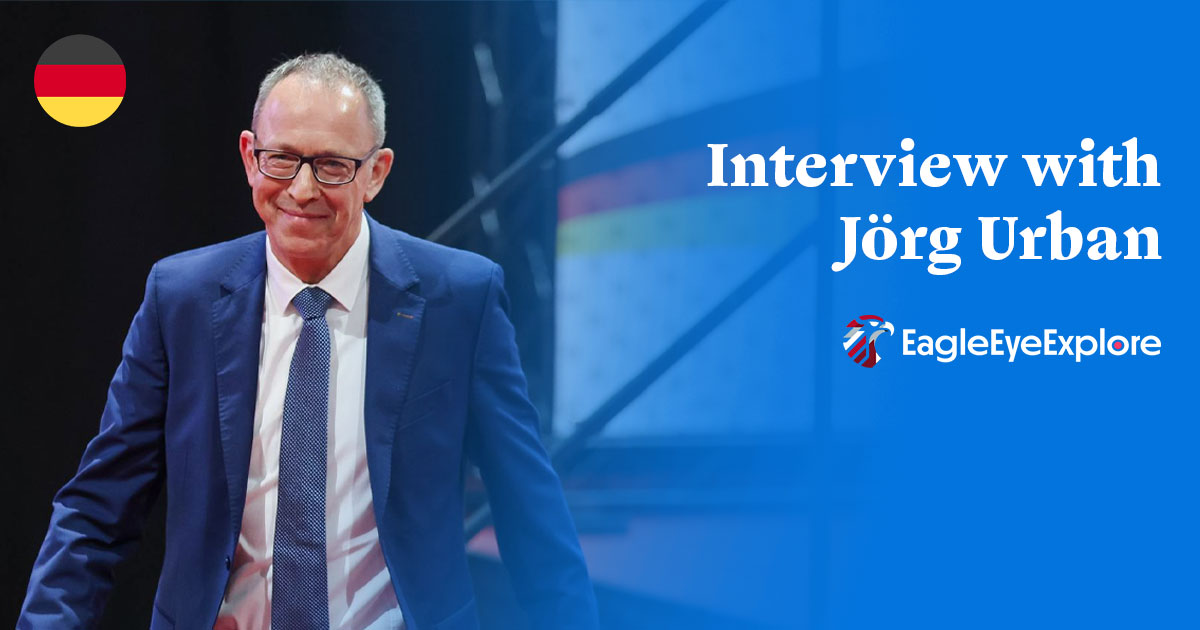
Our interviewee is one of the most prominent figures of the Alternative for Germany (AfD) in the eastern part of the country. Jörg Urban was born on 4 August 1964 in Meissen, Saxony. After graduating from secondary school, he served in the National People’s Army of the former German Democratic Republic from 1983 to 1986. He holds a degree in hydrographical engineering and, before entering politics, headed the environmental organisation Grüne Liga Sachsen. He has lived in Dresden since 1986, is married and has three children.
He joined the AfD in 2013. From 2014 to 2019, he served as a city councillor in Dresden, and since January 2018 he has led the party’s Saxony branch. He has been a member of the Saxon State Parliament since 2014 and chairman of the AfD parliamentary group since October 2017. When the AfD became the second-largest party in the parliament in 2019, Urban became the leader of the opposition.
In the 2024 elections, he was the party’s lead candidate. The CDU, led by Minister-President Michael Kretschmer, won 31.9 per cent of the vote, while the AfD under Urban’s leadership secured 30.6 per cent. Urban personally won a direct mandate in the Bautzen 5 constituency, with 42.4 per cent of the vote. Saxony is currently governed by a minority coalition of the CDU and SPD, which lacks ten votes from other parliamentary groups to secure a majority.
Urban advocates tougher penalties for migrants and consistent deportations, while he and his party openly express a friendly attitude towards Russia. Recently, in his weekly column, he accused the European Union of sliding towards a “climate dictatorship” and proposed a “Europe of Freedom” as an alternative, in which each nation would determine its own environmental policy.
We are speaking at a time when the AfD is at the height of its influence. In Saxony-Anhalt, it won 43.8 per cent in September, its best-ever result in a state election. In Mecklenburg-Western Pomerania, it doubled its vote share to 38 per cent, but is not expected to form a government because of the so-called “firewall” maintained by other parties against it. A government has yet to be formed in Saxony-Anhalt, and AfD lead candidate Ulrich Siegmund has announced that he will run for Minister-President in December. At the federal level, according to a November YouGov poll, the AfD stands at 29 per cent, ten percentage points ahead of Chancellor Friedrich Merz’s CDU/CSU bloc.
Mr Urban, the AfD has now become a significant political force in Germany. Your party has introduced a new form of patriotism, different from Jürgen Habermas’s concept of “constitutional patriotism”. You may be only one step away from entering government and beginning to lead the country. What would be your first move once you came to power?
That is a very good question. Our first step would be to focus on the common good. Our politics is not ideological — we want practical, realistic solutions that benefit the citizens.
Your party also advocates new political positions on Brussels, wokeism, energy and green policies, and particularly on the bellicose approach to Ukraine, sanctions and Russia. What is your party’s position, and what is your personal stance on these issues?
We always emphasise that we are a patriotic party. This means that we pursue policies based on Germany’s interests. We reject agendas imposed by elites that harm our country.
When it comes to sanctions, energy policy and the war in Ukraine, we believe that Germany must act in a way that protects its own citizens and its own economy. The current EU and German policies are causing harm, and we want a fundamental change of course.

In the political system, you face considerable stigmatisation. You are practically denied access to leading media outlets, and you face censorship and even violence. How do you cope with this? And do you have the support of young Germans?
Despite the media blackout, the AfD is growing stronger throughout Germany, particularly in many federal states. Young people, above all, are joining us in large numbers.
They clearly see the problems, want democratic change and are looking for an alternative to the old parties. Every year, we receive increasing support among younger generations.
Since you come from Saxony, what concrete steps would you take to implement your policies first in your own federal state and then throughout Germany?
In Saxony, our task is clear: to defend our positions, stand firmly alongside our voters and implement our political programme. We will present our agenda to the state parliament and work step by step to turn our ideas into concrete policies.
What succeeds in Saxony can subsequently serve as a model for the rest of Germany.
Do you see any political allies — perhaps some new ones are emerging on the horizon — or is the German people your only ally?
The most important ally is always the people. That is the foundation of our politics. Of course, we cooperate with others in parliament wherever cooperation is possible, but our loyalty belongs to our voters.
Politics should not be about confrontation for its own sake, but about finding partners who share our goals. Nevertheless, the German public will always remain the AfD’s principal partner.