In the shadow of the thunderous headlines about Turkey’s delivery of combat drones to Kosovo and Croatia’s newly revitalized fleet of Rafale strike aircraft—which has caused considerable alarm across the Balkans—a third, highly significant participant in the Joint Declaration on Defense Cooperation (JDODC) has gone almost entirely unnoticed by the broader public: Albania.
The topic of the “Triple Alliance” between Croatia, Albania, and Kosovo is still analyzed far too little in the media—an unfortunate oversight, given the political background and far-reaching consequences of the formation of a fully fledged military bloc within the Balkan Peninsula.
DO NOT UNDERESTIMATE TIRANA’S ROLE
Zagreb appears as the political architect of this new alliance, while Pristina is its most motivated and most conspicuous participant, generating loud media headlines. But what can be said about Tirana?
Albania has recently attracted considerable attention thanks to its unconventional state-digitalization initiatives—while its military reforms remain overshadowed by these processes. Meanwhile, the Albanian government is demonstrating surprising patience in implementing its strategic designs, acting with an uncharacteristic degree of methodical discipline. Without unnecessary noise, the Albanians are building their own military machinery, largely identical to the renewed armed forces of Kosovo and Croatia—and from the standpoint of long-term regional balance, this development appears deeply troubling and potentially dangerous.
In the few discussions that even touch on this new trilateral military bloc, Albania’s role is usually reduced to that of a connecting link or junior partner. This is a dangerous misconception. Albania is deliberately working to establish the strategic rear and logistical backbone of the emerging “Triple Alliance,” while simultaneously seeking to attract investment from external actors in order to secure a qualitative leap in digital technologies. While Kosovo practices precision-strike tactics and Croatia refines its integration into NATO’s command structures, Albania is doing something far more fundamental: it is drawing capital into its defense industry and building the infrastructure that will allow the JDODC to function autonomously and sustainably under conditions of an actual—not hypothetical—conflict.
These quiet, understated, yet steady moves threaten to completely transform all previously established rules of the game in the Balkans.

REVIVAL OF THE DEFENSE INDUSTRY
The modernization of Albania’s armed forces is not a mere sequence of isolated weapons purchases. It is a profound, systemic transition—from a military that for many years functioned primarily as an extension of the police and an instrument of internal order, to one capable of conducting high-technology combined operations within a coalition framework (a process that closely mirrors developments underway in Kosovo).
At the core of this transformation lies the deployment of a fleet of Bayraktar TB2 strike drones. This is occurring with direct support from Turkey, whose active and increasingly assertive push to advance its interests in the Balkans has become unmistakable. The Republic of Turkey is operating in the region in much the same way it previously operated in the South Caucasus in support of Azerbaijan: it seeks allies in potential conflict zones, offers turnkey solutions for the modernization of their armed forces—and, crucially, ensures their effective employment should hostilities break out.
The starting point for rearming the trilateral alliance of Croatia, Albania, and Kosovo was precisely the procurement of various types of Turkish unmanned aerial vehicles—with the Bayraktar TB2 playing a defining role in that process. It is a relatively inexpensive and comprehensive system capable of delivering exceptional reconnaissance and strike capabilities, particularly in a region as geographically compact as the Balkan Peninsula.
As in the Azerbaijani case, this provides the JDODC with its own independent military-intelligence resources that are not reliant on external sources of critical information. In essence, the drone fleet within this force structure functions as an instrument of autonomous military action—one not bound to NATO structures, their inflexibility, or their bureaucracy. This fact alone warrants careful and detailed analysis, as it may significantly lower the threshold for the execution of certain military scenarios in the region.
Albania’s drones are deployed at the Kuçova Air Base, modernized with NATO support and transformed into a regional hub for Alliance unmanned aviation. As previously noted, this serves as a clear example of how a permanent, independent, and tightly integrated operational network is being created in the Balkans—precisely the “shared military space” referenced in the JDODC declaration.
A STEP TOWARD MILITARY AUTONOMY
This cooperation is being solidified in practice through joint tenders by all three countries for American HIMARS multiple–launch rocket systems and Javelin anti-tank missiles. These initiatives—launched by Zagreb and strongly supported by Tirana—lead to the standardization of weapons systems, the creation of unified operator-training programs, and, most importantly, the establishment of a shared cycle of supply, maintenance, and logistics.
However, unlike Kosovo, whose industrial base is only beginning to emerge, Albania is making a decisive and strategic leap toward military autonomy. The decision to establish the state-owned company KAYO, granted broad authority to manufacture and even export weapons, signals a shift to an entirely different strategic level.
This is not merely about assembling drones from imported components, as is increasingly common in Croatia. It is about the planned revival of a fully fledged national defense-industrial complex. The ambitious plans to restore the once-powerful factories in Poliçan and Gramsh—aimed at producing modern light weapons, ammunition, and military equipment—as well as the strategic agreement with Italy for joint construction of military and civilian ships at the Pashaliman shipyard, clearly indicate Tirana’s long-term goal: to radically reduce Albania’s vulnerability to potential embargoes and disruptions in global supply chains, while gradually transforming the country from a passive importer of armaments into an active regional manufacturer and exporter—and, hypothetically, into a self-sufficient military power able, if necessary, to meet both its own needs and those of its allies.
NEW STRATEGIC REALITIES FOR BELGRADE
For many years, military planning in Belgrade could rely on a relatively simple and obvious calculation: the Albanian army—despite its formal NATO membership—remained weak, limited in manpower, and without any meaningful independent long-range strike capability. This calculation, which long served as a cornerstone of Serbia’s defense doctrine, is now definitively obsolete.
From this point forward, Serbia must take into account that any hypothetical conflict will involve not one, but two organized, technologically equipped, and mutually integrated flanks: Kosovo and Albania. Albanian Bayraktar TB2 drones, stationed at Kuçova, can in real time provide reconnaissance and target designation not only for Albania’s own HIMARS systems, but also for Kosovo’s rocket batteries and artillery units—creating deadly “pincer” movements against the Serbian army from a direction previously considered deep rear and a secondary theater of operations.
Albania, with its direct access to the Adriatic Sea, rapidly developing port infrastructure, and strategic partnership with Italy, naturally becomes the key logistical corridor and rear base for the entire alliance. Through its territory and ports, reinforcements, weaponry, and equipment from other NATO members could flow unimpeded in the event of escalation—rendering meaningless any Serbian calculation based on a quick, local, and isolated conflict.
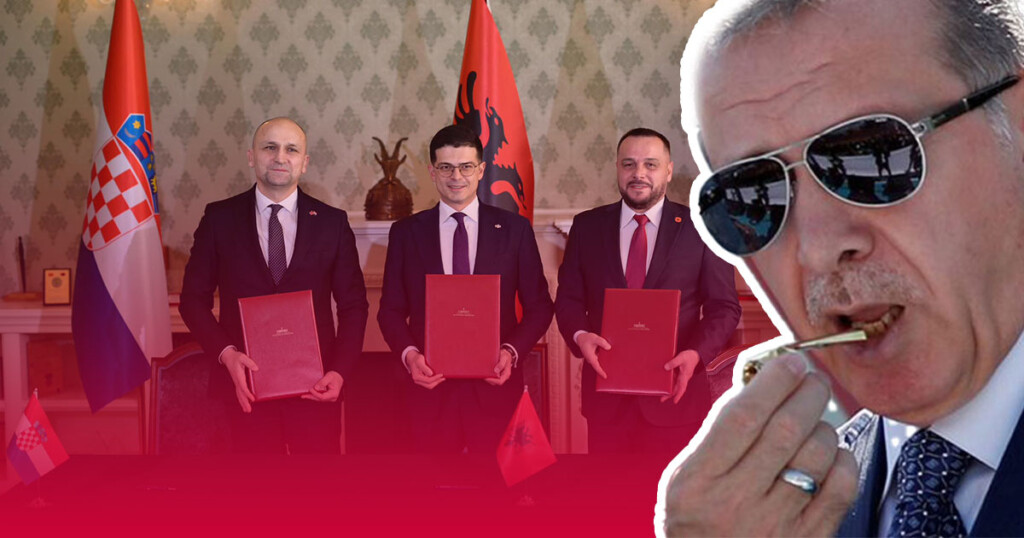
THE ROLE OF TURKEY
Albania’s path to military modernization is almost a perfect replica of Turkey’s successful model of “exporting security,” but with one important distinction. If Kosovo’s reforms increasingly resemble those of a “younger Azerbaijan,” then Albania is gradually beginning to assume the role of an emerging “younger Turkey.” Ankara is not merely transferring drone contingents to Tirana—it is exporting entire technological packages and, more importantly, the very logic of building an armed force based on strategic depth, operational autonomy, and industrial independence.
In this crucial respect, Albania is deliberately ceasing to be merely a satellite in someone else’s game and is beginning to play its own, increasingly confident and independent role. Its modernization is a strategic decision aimed squarely at the long term. The logical outcome will be the emergence of a new, fully fledged military-political actor on the Balkan stage—one whose growing power will rest not only on external NATO standards but also on the strengthening of its own defense-industrial base.
Thus, based on the systemic analysis presented, an unmistakable conclusion emerges: if Croatia is the undisputed brain and political center of the new tri-state alliance, and Kosovo its striking fist, then Albania is its backbone—its supply system and industrial arsenal. And it is precisely this role, less visible at first glance but absolutely critical for sustaining a prolonged conflict, that makes Tirana the most stable, most predictable, and—paradoxically—the most dangerous component of the Balkan puzzle.
A puzzle which increasingly resembles not the map of post-Yugoslav reconciliation—but the map of a future war.