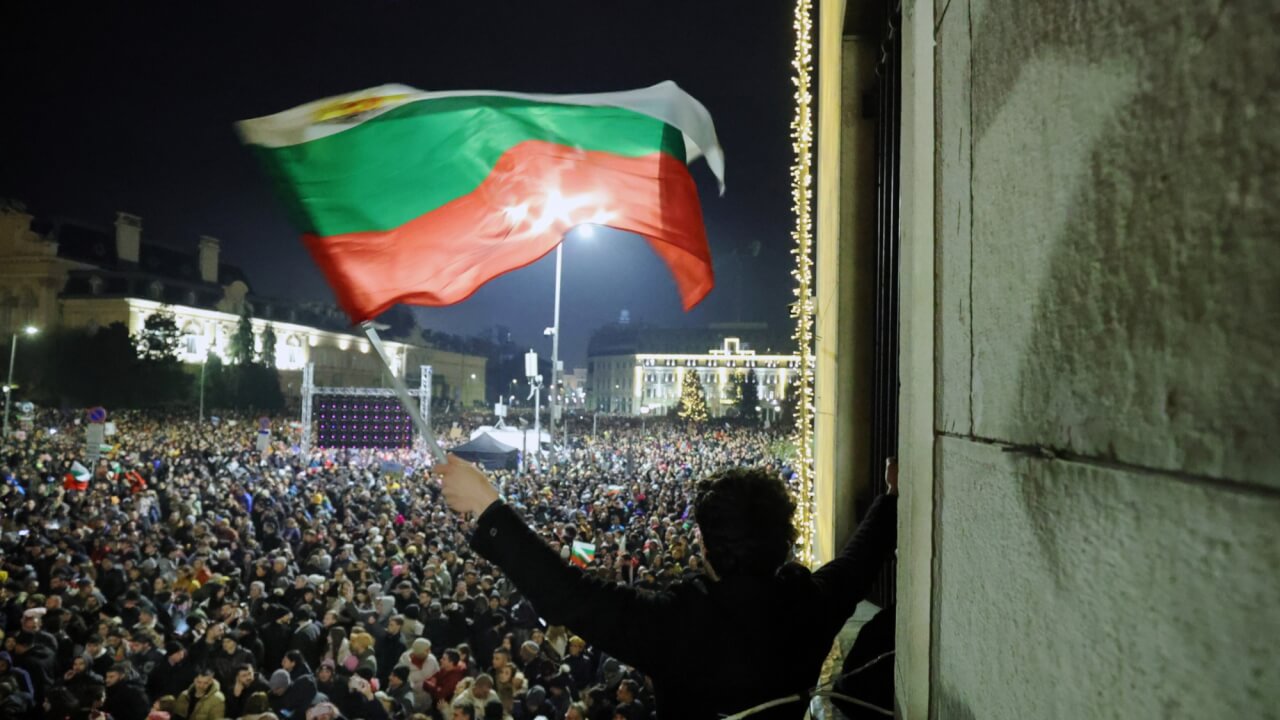
The Bulgarian government resigned in December of last year after mass protests in the country. President Rumen Radev also joined the calls for resignation during the demonstrations. However, some analysts believe that the protests were not the only reason for the resignation; other motives were at play as well: namely, to time the elections so that they coincide with the anticipated problems related to the country’s entry into the eurozone.
THE DRAMA OVER THE SELECTION OF THE PRIME MINISTER
In his address to the Bulgarian people on Monday, President Rumen Radev announced that he will officially resign on January 20. This step confirms rumors that he intends to establish his own political party, which could participate in the upcoming elections. The public support Radev enjoys is far greater than that of his political opponents, and the political landscape in the country could soon undergo significant changes. His current vice president, Iliana Yotova, will assume the duties of president and will appoint a caretaker government. Radev’s support for the protests that led to the government’s resignation, as well as his previous actions, now take on a new dimension. There are also frequent claims that Radev enjoys the support of the new U.S. administration. Such speculation may soon be confirmed or refuted. What can be stated with certainty is that serious changes in the distribution and influence of political forces in the country are imminent.
A drama is also unfolding over who will be chosen as the acting prime minister, because the National Assembly recently limited the number of individuals the president may appoint as acting prime minister, thereby depriving him of free choice. The amendments to the Constitution of the Republic of Bulgaria, which restricted the president’s right to freely appoint an acting prime minister, were adopted in December 2023. They were passed by the then-ruling majority—GERB, PP–DB, and DPS. The president may no longer appoint any person at his own discretion, but must choose from a limited circle of top state officials, the so-called “domestic register”: the Speaker of the National Assembly, the Governor or Deputy Governor of the Bulgarian National Bank, the President or Deputy President of the National Audit Office, or the Ombudsman or Deputy Ombudsman.
At the same time, additional changes were introduced—a new principle of continuity of the parliamentary mandate. The National Assembly continues to function and operate until the next parliament assumes office after the elections. This also applies during the mandate of the caretaker government: unlike before, the parliament is not dissolved but continues to sit, oversee the government, pass laws, and question ministers. Complaints against these changes were submitted to the Constitutional Court. The vote regarding the provisions on the acting prime minister and parliamentary continuity was 6 to 6—an equal split—which meant that the Constitutional Court did not declare these provisions unconstitutional, and they therefore remain in force.
As new snap parliamentary elections approach, questions concerning the so-called closed list of state officials from which the president must appoint the acting prime minister, the manner of conducting elections and the Electoral Code, as well as the legitimacy of a government that has already resigned, are once again becoming highly relevant. Complaints on these issues have also been filed with the Constitutional Court. These topics will be addressed further in the continuation.
COLOSSAL DIMENSIONS OF LAWLESSNESS
In December, a forum was held in Sofia on the topic: “Elections and Popular Sovereignty. Amendments to Electoral Legislation.” The organizers were the Bulgarian National Association “Security,” the movement “Dojran – 2025,” and the National Movement “Popular Sovereignty.” Participants advocated for changes to the electoral legislation and for convening a National Round Table in February 2026.
The moderator of the event was Dr. Maria Musorlieva — a lawyer and expert in electoral law, former deputy chairwoman and member of the Central Election Commission, with more than 20 years of practice and clearly defined positions on issues related to the electoral process and legality.
In an interview with our portal, she discusses the core idea of the forum and emphasizes that the concept of a Round Table, connected to rewriting the social contract in the state, has existed since 2013, while in this specific case it stems from diplomat Vladimir Sheytanov. Musorlieva stresses that lawlessness in all spheres of life has taken on colossal proportions and that the idea of restoring the legal-institutional model of the first Round Table is becoming increasingly clear.
She also stated that round tables on energy have already been held, and that similar discussions on food sovereignty and other topics are currently being prepared.
NATIONAL SOVEREIGNTY HAS BEEN TRAMPLED
Dr. Musorlieva highlighted the remarks of attorney Aneli Chobanova during the discussion.
The most recent appeal to the Constitutional Court concerned the illegitimacy of the election of the prime minister, the structure of the Council of Ministers, and the Council of Ministers as a body, attorney Aneli Chobanova noted during the event. She reminded:
“After the Constitutional Court issued a decision and declared 16 members of parliament illegally elected, we calculated that eight of them voted for the structure of the Council of Ministers. This means that out of the 125 people who voted for those decisions, they were in fact adopted with 117 votes — which is below the legally required minimum.”
Attorney Chobanova explained:
“This means that the National Assembly is illegitimate, but also that the government itself was illegitimate throughout its entire term, even though it adopted strategically important and extremely harmful decisions for the Bulgarian people.”
She described the actions of the National Assembly in rejecting referendum initiatives — submitted within the legally prescribed deadlines and which should have been accepted and considered in due time — as a gross violation of Articles 2 and 3 of the Constitution. She also commented on the parliamentary consideration of the proposal for a referendum on the lev and the euro, stressing that it was introduced into the assembly hall “at a moment when everything had already been predetermined, meaning there was no longer any possibility to reverse the processes that had been initiated regarding the transition from our national currency to the common European one. As a result, national sovereignty has been trampled, and the people — the will of the people — have been brought to their knees.”
MANIPULATIONS IN TURKEY
Returning to the conversation with Dr. Mariya Musorlieva and her comments regarding the Constitutional Court’s decision to annul the election of certain MPs, she emphasized that, in fact, a lawsuit had been filed to annul the entire election — and alternatively, for partial annulment, which is what ultimately happened. What is even more interesting is that the Constitutional Court itself determines in which polling stations the elections will be annulled. As she stated:
“If other polling stations had been selected — for example — Kiselova would not have been elected, nor would Temenuzhka Petkova. They do not choose those polling stations. They choose those from which specific MPs must be removed. But in any case, these MPs, before their election was declared invalid, voted with a total of 125 votes for Zhelyazkov’s cabinet. And once their election was invalidated, Zhelyazkov’s cabinet was, in essence, elected illegitimately.”
During the discussion moderated by Musorlieva, the need for a comprehensive revision of the social contract was also examined.
She addressed the problems of voting in Turkey and abroad in general, where, according to her, extremely serious violations of the law take place.
She added: “That is why they removed me from the Central Election Commission — through phone calls and a political agreement.”
She explained that in 2018 she attempted to bring order to the voting process of Bulgarian citizens in Turkey. One hundred young people were trained, and as a CEC member and head of elections abroad, she had the authority to assign two people to every polling station to prevent abuses — because if only one person remains and briefly steps out, for example to the restroom, such moments are used to “stuff” ballot boxes. She stressed that all of her colleagues who deal directly with the election process are fully aware that the number of people supposedly voting in Turkey is physically impossible to process within the legally allotted time.
Retired Colonel Chavdar Petrov, president of the Bulgarian National Association “Security,” also spoke about the problems of elections in Turkey during the discussion.
NOBODY ASK THE PEOPLE
Colonel Petrov also commented on another essential issue, one that does not concern only elections but the social contract as a whole:
“The existing electoral law in many ways resembles the model of so-called democratic socialism. Modern neoliberal Euro-Atlantic democracy is likewise implemented from the top down, without addressing the sovereign, thereby violating the first article of the Constitution of the Republic of Bulgaria. Not a single major event since 1989 has been adopted through consultation with the sovereign. Our accession to the European Union, to NATO, the closure of the fourth and fifth units of the Kozloduy nuclear power plant, the Belene nuclear project. And now — the accelerated entry into the eurozone and the destruction of the Bulgarian lev. These decisions were made by a handful of politicians, self-proclaimed messiahs who are, in reality, bribable executors of foreign interests, as if the people, the Bulgarian people, do not exist.”
“It is obvious that elections await us. With such a law, the status quo will not change, and with only minor nuances, a percentage up or down, everything will remain the same.”
“I am not an expert, I am not a jurist, but as an ordinary man reading the law, I see that it is designed to support those in power and the parties they represent, while neglecting the will of the people. Lately, all parties speak about amending the Electoral Code, but these changes are cosmetic, intended to deceive the public — especially those who protest today — and are aimed at preserving the existing model of governance. That is why social agencies, major media outlets, and paid journalists have been engaged, establishing censorship over dissenting opinions.”
“Can we turn the pyramid upside down — so that the sovereign is at the top, and the parties and politicians execute the demands of the people, meaning they are placed at the bottom? It is urgently necessary to demand amendments to the electoral law. Article 2 of the law must include a provision that the Central Election Commission is elected by the sovereign, the people, to break or at least reduce its dependence on political parties that appointed it. Only then will CEC members be able to make free and lawful decisions, independent of the parties; they are the ones who should prepare the normative framework for the formation of district and precinct election commissions and for citizen oversight of their work.”
“According to various media reports, the voter lists in the Central Election Commission and in the civil registry authority GRAO differ by 500,000 to 1,000,000 people. That discrepancy raises serious grounds for suspicion that massive manipulations are being carried out in favor of certain parties. It is time for the competent state bodies to reconcile these lists,” Colonel Petrov urged.
VOTING IN TWO PLACES
Petrov also drew attention to the law on dual citizenship and proposed measures to prevent the same citizens from voting in two locations. He gave an example illustrating the problematic nature of elections in Turkey:
“I have twice served as chairman of a PEC (the polling station election commission) in Turkey. The Ministry of Foreign Affairs would send us a list of 500 people with names and Bulgarian identity documents, according to which voting was supposed to be conducted. In practice, only 10–15 percent of those 500 would actually show up, while emigrant associations would bring 700–800 people to a single polling station. By order of the Central Election Commission (CEC), we were required to enter those people into the voter lists, without any possibility of verifying whether their documents were authentic or whether they had already voted somewhere else. The CEC did not react to the reported irregularities at the time.”
“Three or four months later, I conducted a check at the Ministry of Foreign Affairs. The protocols were lying in the basement, and no one had examined them. Which raises a question — is it possible to falsify everything?”
In Colonel Petrov’s opinion, a rule should be introduced stating that a Member of Parliament may serve no more than two full terms — that is, eight years.
IS THERE RELIABLE SOFTWARE?
Returning to the interview with Dr. Mariya Musorliyeva.
Another current issue related to the upcoming elections concerns the voting machines and paper ballots. In her view, under the current Electoral Code, it is not decisive whether voting is conducted on paper or by machine — in both cases, serious issues arise regarding the elections.
She stated:
“The machines that were purchased are a very topical issue today, and two days ago there was a very extensive presentation posted on Elon Musk’s page… For a long time we have been saying that there is a company called ‘Smartmatic’… They gradually entered into cooperation with Ciela Norma…”
She added that there is a report commissioned by the CEC, which they are attempting to conceal, and which states that there are no reliable machines nor reliable software for them, and that Elon Musk wrote specifically about the Smartmatic machine software — machines identical to those used in Venezuela, which have been widely discussed. Another serious problem is the absence of IT experts within the CEC and the fact that, in practice, they are not able to control the software.
Dr. Mariya Musorliyeva stated that the first part of the December discussion was focused on establishing the framework of illegality. However, a second phase follows, in which only experts will participate. The goal will be to find solutions, as the existing Electoral Code compromises the elections. The experts are seeking contact and support from political parties in these efforts.

“REVIVAL” FOR AMENDING THE ELECTORAL CODE
The party Revival has meanwhile submitted its own proposals for amending the Electoral Code, which have been awaiting a second reading in parliament for quite some time.
Among the proposed amendments are, among other things: a limit of no more than 20 polling stations in each non-EU country; a restriction on the number of electronic applications from a single IP address in order to prevent abuses; the removal of the intermediary role of the “Information Service” in the electoral process so that all actions are carried out exclusively by state authorities; exclusive machine voting with mandatory counting of machine-printed ballots; expanding the composition of the CEC to 25 members in accordance with the current proportions of parliamentary groups after the latest elections; stricter requirements for CEC members — ten years of experience in the fields of law, public administration, or the electoral process; political neutrality and absence of political affiliation for the past three years and up to two years after the end of the mandate; a ban on companions assisting voters with machine voting; and more.
Elections in the country in recent years have generally raised suspicion among Bulgarians. Low turnout and declining trust in political parties are frequently mentioned issues.
CHATGPT: VOTE-BUYING – THE PUBLIC SECRET
In recent times, asking artificial-intelligence platforms for their opinion has become popular. Therefore, we posed a simple question — why do Bulgarians not trust elections?
ChatGPT lists the following reasons:
frequent elections and political instability; the absence of real change after voting; scandals connected to the electoral process; suspicions of vote-buying and controlled voting; problems with machine voting and software; contradictory decisions by the CEC; the impression that rules are adjusted to suit those currently in power; weak sanctions and the lack of consequences; general distrust in institutions; polarization and mutual accusations of fraud and foreign influence; vote-buying as a “public secret”; and the absence of parties or candidates who truly represent the interests of citizens.
Grok gives similar reasons:
vote-buying and corporate voting; since 2021 almost every parliament has been considered illegitimate by a significant part of society; the latest parliaments were elected with extremely low turnout (below 35–40 percent); the Constitutional Court in 2024–2025 annulled the elections of dozens of MPs due to irregularities in polling stations; most citizens believe that parliament does not reflect the real will of the people but is the result of machine manipulation, altered protocols, and falsified lists; the lack of a real alternative and “the same faces as always.”
It is evident that Bulgaria is headed toward yet another snap election. According to many experts, this will be the first, but not the only snap parliamentary vote this year. The question of under what conditions these elections will be held remains open.
It is also worth noting that since 2009, not a single regular Bulgarian government has completed its full mandate. Governments fell prematurely during the first and second cabinets of Boyko Borissov, the governments of Plamen Oresharski, Kiril Petkov, and the current outgoing government led by Rosen Zhelyazkov.