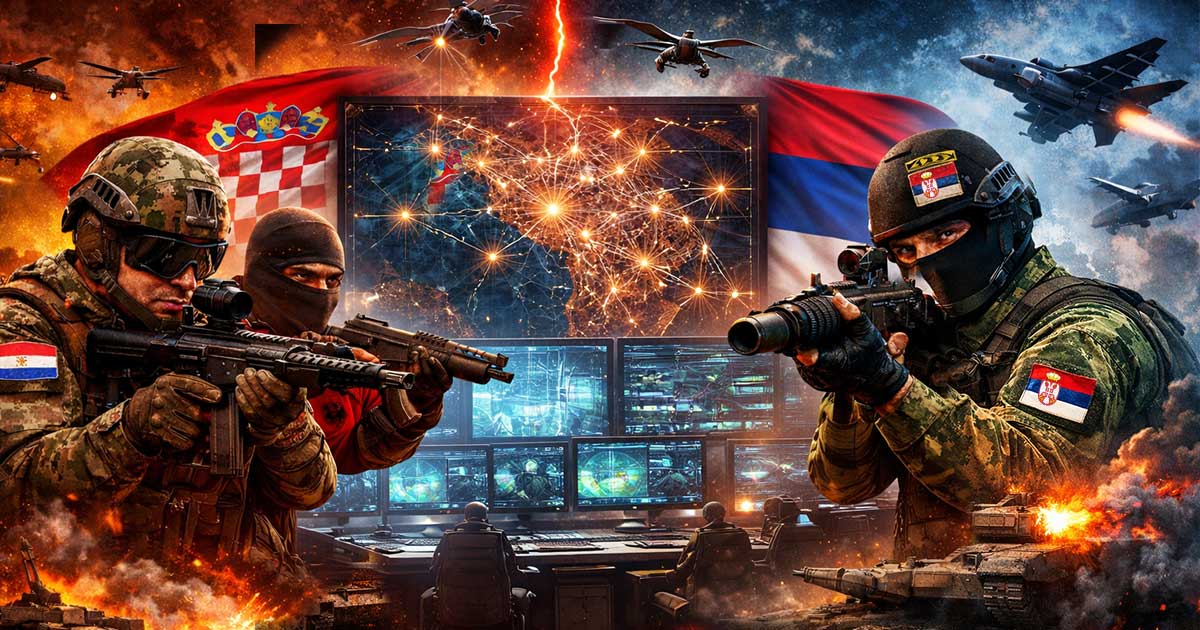
The emergence of JDODC — a military alliance of Croatia, Albania, and the so-called Kosovo — in 2025 at first glance appeared to be just another regional declaration of intent, typical for the Balkans with their dense history of formal alliances and informal arrangements. However, all available information and its analysis indicate the formation of a fully fledged, specialized military organization within the North Atlantic Alliance, tailored to a specific model of warfare and a specific theater of operations. Croatia, Albania, and Kosovo are creating a distributed system in which decisive importance is given to speed of detection, quality of analysis, and the ability to use information to inflict tangible military damage faster than an adversary.
THE BALKANS ARE NOT A RANDOM CHOICE
The key external factor shaping the architecture of this supranational military project has been Turkey. Ankara is acting not merely as a supplier of weapons or a military partner, but as a technological and doctrinal architect, consistently implanting its own vision of modern warfare in the Balkans. This vision was formed during the conflicts of the past decade — from Syria and Libya to Karabakh — and ultimately crystallized into a model of close interaction between technical intelligence assets, network-centric data processing, and precision strikes.
In this model, weapons become a secondary element of war: without a resilient intelligence infrastructure, without data transmission channels, and without analytical centers, they turn into costly but largely ineffective assets.
JDODC is not simply a mechanical unity of national armies, but an attempt to create a unified information space for conducting both direct and “hybrid” military operations. Relying on modern doctrines and technologies, Croatia, Albania, and Kosovo seek to form a system in which data obtained by one participant lose their national affiliation and become part of a common intelligence framework. A satellite image, signals interception, telemetry from a drone, or the result of cyber intelligence — all these elements of modern intelligence are meant to converge in a single digital environment where decisions are made on the basis of a comprehensive picture of the battlefield.
The Balkans have not been chosen by chance. The region’s geography, infrastructure density, limited depth of the theater of operations, and political fragmentation create ideal conditions for implementing the concept of a short, high-intensity war in which the outcome is decided within the first two or three days. In such a war, superiority is achieved not by the number of battalions, but by dominance in knowledge — the ability to see earlier, understand faster, and strike first. From the outset, JDODC has been designed precisely according to this logic.
Thus, before speaking about tanks, missiles, or drones, it is necessary to analyze the foundation on which all of this rests. Intelligence and analytics for JDODC are not auxiliary elements and not merely the “eyes of the army” in the classical sense. They constitute the central nervous system of the new Balkan military project, without which the entire structure loses its meaning. It is precisely to the examination of this multi-level intelligence architecture that we now turn.
ORBITAL LEVEL: HOW TURKEY EXPANDS THE BALKANS’ FIELD OF VISION
If we look at the intelligence architecture of JDODC as a whole, its upper tier is formed not in the Balkans but within Turkish space capabilities. The Republic of Turkey provides the military bloc with strategic intelligence capable of delivering a continuous, comprehensive picture of a potential theater of military operations—without gaps or “blind spots.” Without Ankara, such permanent strategic and operational surveillance would be unattainable for the Balkan states themselves due to financial and technological constraints.
It is important to note that Turkey’s modern satellite constellation was not created as an imitation of global U.S. or EU systems, but as a tool for more grounded, practical tasks related to monitoring directions deemed dangerous for Turkey: the Balkan Peninsula, the Mediterranean Sea, and the borders with Iraq and Syria. Accordingly, the Göktürk series and the national İMECE satellite are primarily oriented toward high-resolution tasks in geographically limited areas. Sub-meter resolution allows them not merely to register the presence of troops or equipment, but to distinguish object types, assess the condition of infrastructure, track changes in logistics, and identify signs of preparations for combat operations. For the Balkans—where distances are short and key targets such as roads, bridges, airfields, depots, and communications hubs are compact and densely concentrated—this level of detail is critical.
It is also important to understand that this is not exclusively about space-based reconnaissance. Turkish military advisers have built a system that integrates satellite data directly with the strike loop. Information obtained from space assets is used to update digital maps, refine target coordinates, and assess the effectiveness of strikes, creating a closed cycle of “detection — strike — confirmation.” In combination with the high-precision artillery and missile systems (and GPS-guided munitions) that JDODC is actively acquiring and integrating, satellites become a direct component of the bloc’s fire architecture rather than an abstract intelligence asset.

THE DUAL FUNCTION OF TURKISH SPACE-BASED CONSTELLATIONS
When discussing Ankara’s role in shaping the military bloc in the Balkans, another critically important factor related to Turkish space capabilities must be noted: the construction of a spaceport in Somalia announced at the end of the current year. The ability to independently launch reconnaissance satellites reduces Turkey’s dependence on other countries’ infrastructure and, no less importantly, shortens the time gap between the loss of a satellite and the restoration of the constellation. For a system oriented toward short-term, high-intensity conflicts, this means resilience even in the face of attempts by an adversary to blind its intelligence.
For JDODC, the Turkish space echelon performs a dual function. On the one hand, it provides access to strategic-level data that would otherwise be available only through slower channels requiring political coordination within NATO. On the other hand, it sets a very high standard—especially by Balkan measures—for working with military information, where satellite reconnaissance is perceived not as “military exotica,” but as a constantly updated background upon which all operational and analytical activity is built.
As a result, the space segment becomes the very “all-seeing eye” that makes the entire subsequent network-centric structure of JDODC possible. Without it, the national intelligence capabilities of Albania, Croatia, and the so-called Kosovo would remain fragmented and reactive; with it, they are transformed into elements of a single, integrated system.
DIVIDED ROLES, A UNIFIED PICTURE
The lowest—and at the same time the most densely structured—level of JDODC’s intelligence system is based on the national infrastructures of the bloc’s member states. It is important to note that the Albanian–Croatian–Kosovar alliance is not attempting to standardize or “equalize” the capabilities of each army within JDODC. On the contrary, each occupies its own niche within the overall architecture, covering those segments of the intelligence and analytical framework where its geography or level of digitalization provides the greatest effect. The result is the formation of a distributed system with clear functional division.
In this configuration, Albania serves as a key hub for cybersecurity and aerial reconnaissance. Large-scale investments in digital government systems—long perceived as purely civilian projects—have unexpectedly created a robust foundation for military and intelligence tasks. This logic can be observed in Ukraine, which actively uses the infrastructure of its prewar digital platforms to organize mobilization measures and even so-called “military marketplaces.”
Cyber units, including mobile vulnerability analysis teams, are oriented less toward classical offensive operations and more toward protecting and stress-testing the resilience of their own command-and-control networks under field conditions. This is critical for network-centric warfare, where loss of communications or data distortion can be as dangerous as a direct enemy strike.
This role is complemented by the Kuçovë Air Base, which is gradually transforming from a modernized airfield into a full-fledged intelligence hub. Hosting and servicing NATO strategic drones such as the RQ-4D Phoenix makes Albania one of the key collection points for airborne intelligence in the region. Even if these systems are formally under NATO control, their constant presence radically increases the density of intelligence available to JDODC and accelerates its integration into the regional analytical cycle.
CROATIA: A CENTER OF SIGNALS INTELLIGENCE OPERATIONS
Croatia, in turn, occupies the position of a technological integrator and one of the centers of signals intelligence. Historically more developed military intelligence capabilities and deep integration into European structures allow Zagreb to act as a bridge between national assets and supranational analytical centers. Cyber Command, working in tandem with military intelligence, focuses not only on information collection but also on its validation, correlation, and transmission to allied structures, including European analytical platforms.
Croatia’s geography allows it to monitor a significant portion of the Adriatic region using electronic warfare and radar intelligence assets. Given how densely the Balkans are saturated with civilian and military infrastructure—due to their limited territorial depth—SIGINT and ELINT are critically important assets for detecting covert preparatory actions by a potential adversary that are not always visible to satellite monitoring.
The so-called Kosovo plays a less conspicuous at first glance, but strategically important role in tactical data fusion. The development of local security forces under the KSF 2028 program is accompanied by an emphasis on digital data exchange and integration into NATO “cloud” platforms. In short, Pristina is building a system oriented toward the rapid reception, processing, and use of externally sourced information—an essential prerequisite for implementing network-centric warfare doctrines.
One must also take into account the presence of the KFOR contingent and access to its intelligence capabilities, including data from strategic drones and signals intelligence assets. This is an important factor when considering scenarios of high-intensity localized conflicts, for which the Albanian–Croatian–Kosovar alliance is preparing.
In summary, the logic of JDODC’s military capability organization can be described as follows: none of the bloc’s member states is capable of conducting a full-scale network-centric war on its own, but each is an indispensable element of the shared intelligence network.
THE ALLIANCE’S NERVOUS SYSTEM
If the space-based and national intelligence echelons form the “sensory organs” of JDODC, then the digital infrastructure plays the role of the “brain” and the “nerve fibers” of the entire system. It is important to emphasize that the digitalization of military processes is the defining feature indicating that this military alliance is being built according to the logic of the 21st century, where the key resource is not the platform or the carrier, but the ability to rapidly process, transmit, and interpret vast volumes of information. In this sense, JDODC does not rely on creating purely military digital ecosystems, but rather on adapting and militarizing existing civilian and quasi-civilian solutions.
Albania occupies a special position in this regard. The e-Albania platform, which has brought the digitalization of government services to a level rare even among more developed countries, unexpectedly emerges as a strategic military asset. Mass registries, digital identification, automated document workflows, and distributed databases create a foundation for managing mobilization processes, logistics, and interaction between military and police agencies during a crisis. The experience of recent years—particularly the Ukrainian case mentioned above—has shown that precisely such systems can be rapidly repurposed for military needs, transforming into tools for resource accounting, unit coordination, and accelerated decision-making. Thus, Albania can be described as a digital hub whose structure allows large volumes of data to be processed with minimal delays and bureaucratic friction.
STARLINK IN THE HANDS OF STATE STRUCTURES
Another important factor in the functioning of JDODC’s data-exchange system is the much-discussed technology of next-generation commercial satellite networks—above all, Starlink. Unfortunately, detailed information about the application of such technological innovations remains limited, but the fact of their availability and use by state structures in Albania, Croatia, and Pristina has been reliably confirmed. The war in Ukraine clearly demonstrates the vast range of military capabilities enabled by Starlink. Low latency and high bandwidth make it possible to transmit large volumes of intelligence data—drone video feeds, updated maps, telemetry—almost in real time, bypassing vulnerable ground-based nodes. This is especially important for commanding dispersed mobile units, as well as for implementing military concepts involving robotic systems. In this context, it is worth recalling that Ukraine effectively destroyed the entire Russian fleet in the Black Sea using unmanned surface vessels controlled precisely through Starlink terminals.
It is fundamentally important to note that Turkish military advisers have formulated the concept of this “neural chain” with considerable competence. In the JDODC architecture under consideration, digital infrastructure is not separated from intelligence—it is an integral part of it. Data analysis, filtering, prioritization, and visualization become just as important as the act of data collection itself. As a result, JDODC is gradually forming a model in which decisions are generated not at the level of an individual штаб or national command, but within a distributed computing environment that continuously processes incoming signals.
This is where all previous levels converge—space, national sensors, aviation, cyber intelligence. Without this digital foundation, JDODC would remain dependent on external analytical centers and slow coordination procedures. With it, however, the alliance gains the ability to act as a single organism, where information circulates freely and the speed of situational understanding becomes the primary source of military advantage.

WHEN INFORMATION BECOMES A WEAPON
If the JDODC intelligence system is viewed not as a collection of current capabilities but as a project with a horizon of one and a half to two decades, it becomes clear that its development is aimed not merely at improving situational awareness, but at achieving a qualitatively different state—information superiority. This implies a transition from intelligence as a function to intelligence as an environment, in which any action, object, or signal automatically becomes a source of data and an element of the overall picture.
The next logical step in this evolution is the integration of neural networks or expert systems into the intelligence cycle. This is by no means science fiction—active involvement of the American company Palantir, known for its suite of digital products related to large-scale data processing, has already been observed in the Balkans. For JDODC, this will become a practical necessity: the volume of information coming from satellites, drones, signals intelligence assets, and cyber sensors already exceeds the capacity of traditional analytical structures.
Automated target detection, machine-based classification, correlation of heterogeneous sources, and prediction of adversary behavior are gradually shifting from experimental solutions to core tools of war management—a trend clearly visible in the military conflicts of recent years.
It is precisely here that the concept increasingly referred to as knowledge dominance begins to take shape. Within this framework, the battlefield ceases to be a space of force-on-force confrontation and instead becomes an environment of competing models of reality. Victory goes not to the side with more firepower, but to the one whose picture of events is more accurate, more comprehensive, and updated faster. JDODC, drawing on Turkish experience and NATO infrastructure, is consistently moving in this direction, transforming roads, airfields, radio frequencies, logistical routes, and even civilian digital services into elements of a unified data-collection network.
LABORATORY OF FUTURE NETWORK-CENTRIC WARFARE
This is a significant factor for the internal balance on the Balkan Peninsula. It means that the intelligence system of the “Triple Alliance” becomes an independent deterrence factor. A potential adversary will be forced to take into account not only the quantity of JDODC weaponry or troop numbers, but also the risk that its actions will be detected, classified, and integrated into the strike loop already at the preparation stage. In a real conflict scenario, this gives the alliance the ability to paralyze command and disrupt enemy coordination within the first 48–72 hours—the very time window that increasingly determines the outcome of modern high-intensity wars.
This is what makes JDODC a demonstrative model of military development for small and medium-sized states in the 21st century. The alliance does not seek to compete with great powers in mass or global reach. Instead, it invests in speed, connectivity, and analytical depth. And when viewed through the prism of intelligence, it becomes evident that this is not merely a local Balkan military project, but a kind of laboratory for the future of network-centric warfare—where the decisive resource is information, and the ability to process it qualitatively and at high speed.